
Updated: October 2026
You finish three 12-hour shifts, look at your days off, and realize one is already consumed by sleep, laundry, and catching up on everything you postponed. Someone says, “But you only work three days a week.” Meanwhile, you’re wondering how you’re supposed to have a life outside the hospital.
Nursing work-life balance starts with accounting for what the job actually takes: the shift, the commute, the preparation, and the recovery afterward. For new nurses, learning the job adds another layer of mental effort. A workable routine leaves room for your basic needs, relationships, and interests without requiring you to spend every day off recovering.
This article expands on an early FreshRN Podcast conversation about work-life balance for new nurses. You can listen below, then use the practical examples to build a routine that fits your life.
Listen: Work Life Balance for New Nurses
Listen to more episodes on Apple Podcasts or Spotify.
In this episode, Kati Kleber and Elizabeth Mills discuss preparation, communication, self-advocacy, and adjusting to life as a new nurse. Roles and credentials mentioned in the recording reflect the time it was recorded.
Why days off do not always feel like time off
A scheduled 12-hour shift can occupy considerably more of your day once you include getting ready, commuting, and giving report. Add meals and sleep, and there may be very little usable time between shifts. Working nights can make family schedules and social plans harder to coordinate.
The CDC’s National Institute for Occupational Safety and Health (NIOSH) explains that shift work and long hours can disrupt sleep and reduce time for family and other responsibilities. That context matters when you decide what you can reasonably fit into a workweek.
Your recovery time belongs on the calendar. If you routinely schedule errands, appointments, and social commitments into every open hour, your schedule may look possible on paper while being exhausting to live.
1. Make workday preparation simpler
The goal is to reduce decisions when you are tired. You do not need an elaborate meal-prep routine or a perfectly organized house.
- Before a stretch of shifts, check that you have clean scrubs, your badge, work shoes, and the supplies you actually use.
- Choose a few repeatable meals and pack food you will realistically eat during a busy shift. Keep a backup snack available.
- Decide what dinner will look like after work. Leftovers, a freezer meal, or a simple sandwich can be enough.
- Keep a spare set of scrubs available if your workplace allows it.
- Leave nonessential chores for another day instead of using sleep time to finish them.
Start with the one recurring problem that makes your mornings or evenings harder. Fixing the missing badge or the nightly dinner scramble is more useful than building a complicated system you cannot maintain.
2. Protect sleep and recovery
Treat your sleep window as an actual commitment when you plan childcare, appointments, and household responsibilities. If you work nights, tell the people in your home when you will be sleeping and what needs to wait.
- Make your room as dark, quiet, and comfortable as you can.
- Use phone settings to limit nonessential interruptions while allowing necessary emergency contacts.
- Avoid routinely turning the time between shifts into time for errands or social plans.
- Keep the first day after a demanding stretch lighter when your circumstances allow it.
Fatigue is a safety concern. If you are too sleepy to drive safely after a shift, arrange a safe alternative instead of trying to push through. Persistent trouble sleeping or excessive sleepiness deserves a conversation with a healthcare professional.
3. Make expectations at home specific
People who do not work your schedule may underestimate what a workday requires. “I need more help” can be difficult to act on. Specific agreements make the work visible.
- “On the days I work, can you handle dinner and the kitchen cleanup?”
- “I’ll be sleeping until 3 p.m. after my night shift. Please schedule deliveries and nonurgent calls for later.”
- “I want to see everyone, but I can’t host the morning after working overnight.”
Use a shared calendar if it helps. Include shifts, sleep after nights, school responsibilities, and the household tasks each person owns. An agreement works better when someone owns the task through completion, including remembering it.
4. Decide your overtime boundaries before the request arrives
An extra shift can help with a specific financial goal. It can also consume the only time you had to recover. Before accepting optional overtime, look at the whole week: your existing shifts, commute, sleep opportunities, family commitments, and how you are already feeling.
For an optional pickup request, a brief answer is enough: “I’m not available for an extra shift this week.” You do not have to prove that your plans are important. Follow workplace policies and applicable requirements for scheduled shifts, call, and emergencies; those are different from volunteering for an additional shift.
If you choose overtime, give it a purpose and a limit. A defined savings goal and a planned end date make it easier to notice when temporary extra work has become the default.
5. Give work a stopping point
New nurses often keep replaying the shift after they leave. A short transition routine can help create a stopping point: finish the required handoff, identify one learning question for later, change clothes, and move into the next part of your day. If you have a concrete concern about patient care or a possible error, use your unit’s reporting and escalation process promptly. Replaying the situation alone is not a substitute for getting the right person involved.
For routine learning questions, set a short study window on a day off rather than letting work consume the entire day. Process difficult experiences with an appropriate colleague, mentor, counselor, or support program while protecting patient confidentiality.
6. Adjust your expectations while you are learning
In your first months, even familiar tasks take deliberate thought. You are learning the charting system, unit routines, clinical priorities, and when to ask for help. Comparing your pace with an experienced nurse’s pace misses how much practice sits behind their efficiency. Ask your preceptor for specific feedback: “What is one change that would help me finish my shift more smoothly?” Focus on a manageable skill instead of treating every difficult day as proof you are failing.
Keep something in your week that has nothing to do with nursing. It can be small: a walk with a friend, reading, a hobby, or dinner with your family. Your life outside work needs some actual space in the schedule.
7. Recognize when the job needs to change
Preparation and boundaries have limits. Unsafe staffing, repeated missed breaks, bullying, unpredictable scheduling, or routinely staying well past your shift require attention beyond your personal routine. Bring specific patterns to your manager or the appropriate workplace channel: how often you stay late, what prevents breaks, or which scheduling changes interfere with recovery. Ask about concrete changes such as break coverage, orientation support, scheduling consistency, or a different shift pattern.
If the situation remains unsustainable, it’s reasonable to consider a different unit, schedule, or employer. If persistent dread, irritability, sleep problems, or difficulty recovering are affecting your daily life, seek support from a healthcare professional or mental health professional. You do not need to wait until you cannot function.
A practical starting point for this week
Choose one workday problem to simplify, one recovery window to protect, and one expectation to communicate. Try those changes for a couple of weeks and notice what improves. If basic needs still cannot fit around the job, that is useful information about the schedule or workload.
Evidence-based resources
- NIOSH Training for Nurses on Shift Work and Long Work Hours: guidance for nurses and managers on fatigue and strategies at home and at work.
- How Shift Work and Long Work Hours Increase Health and Safety Risks: background on sleep, recovery, and time outside work.
Wish Your 12-Hour Shift Had A Map?👇
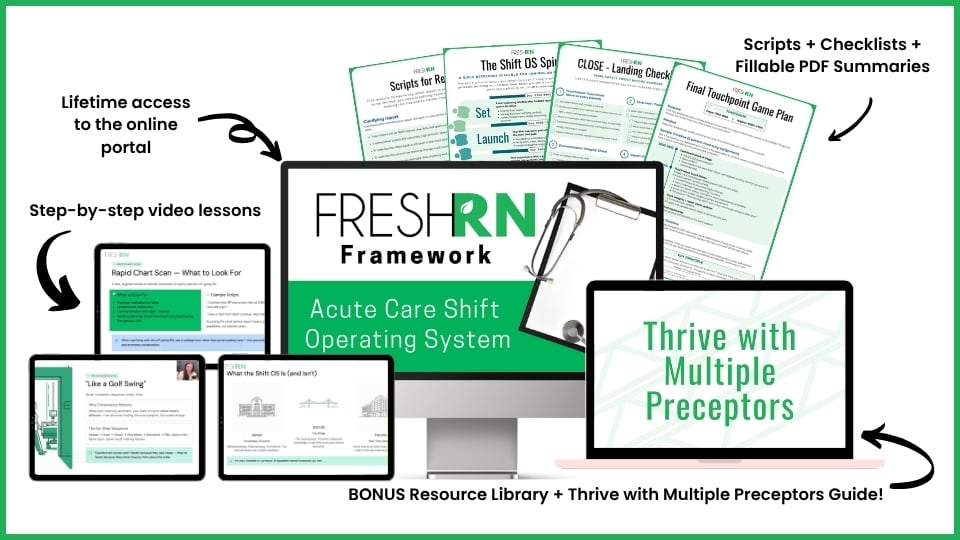
Turn a chaotic 12-hour acute care shift into a clear, structured rhythm. We cover: how to launch after report, prioritize when everything feels urgent, and finish with a clean handoff.
See What’s Inside Shift OS →

0 Comments