
In the high-stakes world of nursing, giving a clear and complete shift report can make or break your handoff. Whether you’re a new grad who gets nervous before report or an experienced nurse who wants to get faster and more confident, this guide walks you through exactly how to give a nursing report.
However, if you want this information in your inbox that you can save, sign up for my free 3-day email course. I’ll send you the first lesson immediately + my go-to Med-Surg nursing report sheet as a bonus.

Table of Contents
Introduction to Shift Reporting
Psst… Check out my podcast episode “nursing report for newbies” for more info on this 👇
Nursing report (or just referred to as “report” around a nursing unit), is a fast-paced information-sharing time between shifts. The off-going nurse reports off to the oncoming nurse in a systematic way.
Shift reports in nursing are vital for a seamless transition of care between nurses. This will allow you to quickly learn about each patient and what you need to do for the next shift (typically 12 hours). Here’s how they ensure three key things:
- Continuity of Care: By detailing a patient’s medical history, current condition, and treatment plan, the oncoming nurse gets a full picture. This allows them to pick up right where the outgoing nurse left off, avoiding delays or missed steps.
- Patient Safety: Shift reports highlight any potential risks or changes in a patient’s status. This early warning system helps the new nurse identify and address any concerns quickly, reducing the chance of complications.
- Effective Communication: Shift reports provide a structured way for nurses to exchange crucial information. This ensures everyone is on the same page, preventing misunderstandings and promoting collaboration that benefits the patient.
However, something new RNs tend to overlook is that it’s not just about giving report. Nurses have to learn the best way to get report too!
Different Types of Nursing Shift Report
New nurses must to learn how to receive report at the beginning of their shift, recover from report, and then give report at the end of their shift. They may also give an abbreviated focused report if their patient is going to a surgery or procedure during their shift.
Also, report between various units looks different. An ED RN reporting to another ED RN is much shorter than ICU RN to ICU RN. Med-surg is in the middle in terms of details.
➡️ If you’re going to work in med surg, check out my Med-Surg Report Sheet article, and this FREE mini course on report!
Preparing to Receive Nursing Report
After you clock in for your shift, you’ll go check your assignment. Make sure you double-check this – you don’t want to get a report on the wrong patient. (YIKES, I’ve been there!)
Ensure you have enough nursing report sheets (here’s my fave), then pre-fill out a few critical details, if able. Don’t tell the off-going RN you’re not ready just to pre-fill basics. Only do this if you’ve got about 3-7 minutes.
Pre-fill:
- Patient name
- Code status
- Attending provider/team
- Pertinent allergies
- Isolation status
Why do this? When receiving report, (especially when we’re new!) we want to reduce as much friction as possible. It is very easy to get tripped up on names, long allergy lists, or weird isolation precautions. Then we’re behind when the really important stuff is discussed, like their admitting diagnosis + important admission events.
(And if you want more tips on how to prep like a pro to avoid major landmines, you’ve got to sign up for my 3-lesson email course!)
Receiving Nursing Report
Next, you’ll go see who you are getting report from. If you’re new to a unit, hopefully, you’re learning the personalities of the other RNs. You’ll begin to realize who is long-winded, who gets distracted easily, who is concise but thorough, and who gives minimal information that you have to ask questions to ensure you get the full story.
I tend to try to see the concise RNs first during this fast-paced 30-minute period of time. I don’t want to start off with the long-winded RN and then I’m pretty behind. It is my goal to make the most of these 30 minutes. Use acronyms as much as possible to stay caught up, especially for those fast-talking RNs.
Ensure you have an understanding of:
- Why they’re here
- What their current status is
- What the plan is for the next 12 hours
- What the overall big picture goals are to get discharged
If you have this, you’re ⭐️ golden ⭐️ because all of those details, like the size of their IV, dressing change orders, and blood glucose frequency, can be found in the chart.
Recovering From Nursing Report
This might be a hot take, but I feel very strongly about the importance of post-report recovery. I highly recommend a focused 30-minutes to really understand your full patient load and make a plan to optimize the first two hours of your shift, which I call the Launch Sequence. I detail how I approach this systematically in my FreshRN Acute Care Shift Operating System so that you begin each shift with ownership, intention, and confidence.
Giving Report – End of Shift
Let’s saying you’re going to give nursing report at the end of your shift to the next RN.
Information Gathering
If you’re nearing the end of your shift, you likely have almost all of this information on your report sheet. However, if you don’t, let’s run through what the next RN will need to safely assume care for your patient.
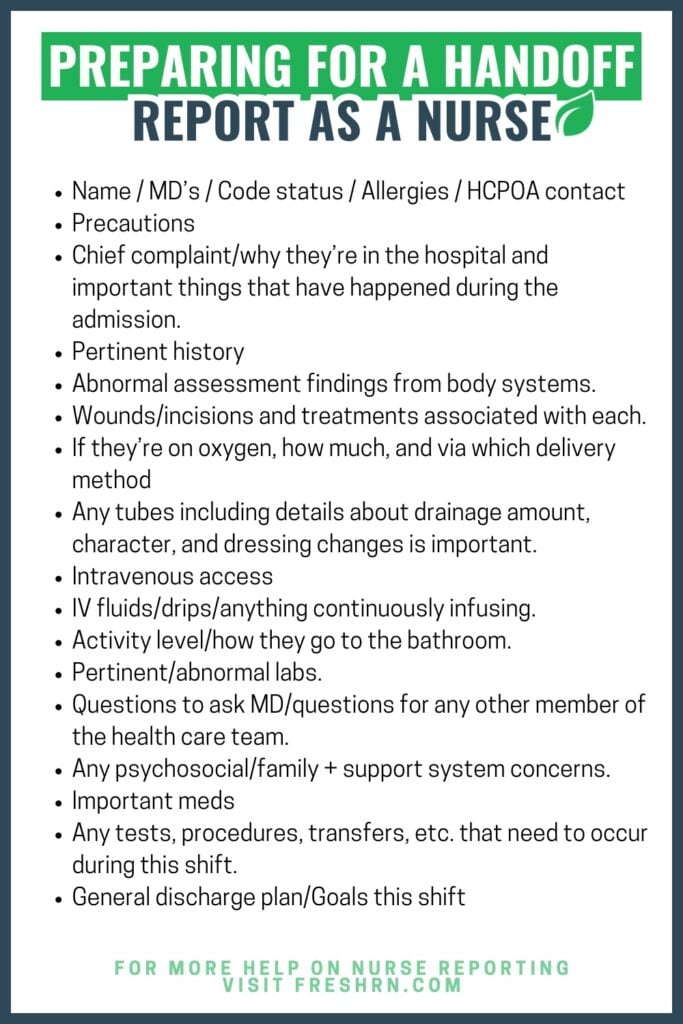
- Name / Attending Provider + Team / Code status / Allergies
- Precautions (fall, seizure, infection prevention, bleeding, etc.).
- Chief complaint/why they’re in the hospital, and important things that have happened during the admission.
- Pertinent history (it’ll take time to figure out what is pertinent or not, don’t get hung up on this one. You’ll also figure out, with time, shorthand/abbreviations for history).
- Abnormal assessment findings from body systems.
- Wounds/incisions and treatments associated with each.
- If they’re on any type of oxygen, how much, and via which delivery method (nasal cannula, face mask, non-rebreather, ventilator settings, etc.).
- Any tubes (feeding tubes, foley catheter, rectal tube, etc.), including details about drainage amount, character, and dressing changes is important.
- Intravenous access (IV, central line, port, etc.) + any other equipment attached to the patient (this can be lengthy for ICU)
- IV fluids/drips/anything continuously infusing.
- Activity level/how they go to the bathroom.
- Pertinent/abnormal labs.
- Questions to ask MD/questions for any other member of the health care team.
- Any psychosocial/family + support system concerns.
- Important meds (you can look up this stuff in the chart, but they may mention some meds).
- Any tests, procedures, transfers, etc. that need to occur during this shift.
- General discharge plan/what are our goals this shift? (get out of bed 3 times, eat, pass swallow evaluation, transfer out of ICU, etc.).
Checklist Development
The fast-paced nature of healthcare can sometimes lead to crucial details being missed. Here’s where standardized checklists come in as powerful tools to streamline communication and guarantee a comprehensive handover.
Checklists empower nurses! They act as a safety net. Even the best of us get fatigued, distracted, or make honest mistakes. Having checklists helps us minimize errors by giving us visual cues to ensure we’re not missing anything. This saves valuable time during shift changes. Ultimately, checklists enhance efficiency and directly improve patient safety by ensuring all critical information is exchanged.
How to Give Nursing Report – Helpful Tips
Clear and concise communication is the cornerstone of effective teamwork, especially in healthcare.
Here are a few of my fave tips:
- ✅ When deciding on a report sheet, give yourself some time with each sheet. You need to learn the sheet a little bit and where things are to see if it fits your needs.
- ✅ Approach report like a golf swing, do it the same way every time. Your report sheet provides you with great visual cues, and you can just work your way through the sheet to guide your discussion.
- ✅ Don’t get too focused on filling out each box in your report sheet. Patients are dynamic and different, so not every box may be necessary… and you may waste time trying to find irrelevant and/or unnecessary info just to fill every single one out.
- ✅ When giving shift change report to a nurse on the same unit, give report at the bedside. A lot of questions can be answered just by visually laying eyes on the patient. This also allows the patient to be part of the process. The more the patient is informed and included, the less questions and concerns they have because you are being transparent with them in the plan of care.
- Remember: the off-going nurse’s job is to paint a clinical picture, not ensure the oncoming nurse’s report sheet is filled out perfectly.
Nurse SBAR Report Sheet
Let’s talk about SBAR for a second. SBAR (situation, background, assessment, recommendation) is a standardized tool that helps healthcare providers communicate with clarity, brevity, and intention. This is the ideal tool to use when communicating concerns and status changes. (A status change = when a patient was fine and now they’re not.)
Nursing report is a different situation. When changing shifts and giving one another report, we are giving a comprehensive clinical picture of a patient to enable the next RN to provide holistic care.
SBAR = focused
Nursing report = comprehensive
Let’s go through more details of what SBAR really means. Let’s say you’re a new RN with your preceptor and notice a change. Here’s how you could structure your communication of that change to your preceptor.
SBAR stands for:
- Situation: A brief yet critical statement outlining the immediate issue or concern. Who is the patient? What is the current situation? For example: “I’m concerned about Mr. Jones in room 205. His oxygen saturation has dropped to 86% in the past hour and he looks like he’s working harder to breathe.”
- Background: Provide relevant information about the patient. This may include medical history, current medications, allergies, or recent procedures. Keep it focused on information pertinent to the situation. Continuing the example: “Mr. Jones has a history of COPD and is on 02 at 2L nasal cannula.”
- Assessment: Your professional judgment of the situation. What do your observations and findings suggest? Analyze the information and explain your interpretation. In our example: “Based on the drop in oxygen saturation, I’m concerned about potential respiratory distress and him continuing to need more O2 to maintain the same oxygen level.”
- Recommendation: Clearly state your proposed course of action. Do you recommend further assessment, intervention, or consultation? Be specific: “I think increasing Mr. Jones’ oxygen to 4L nasal cannula and talking to the attending would be wise.”

How to Handle Orders Placed At or Around Shift Change
- Typically, if an order is placed at shift change, it’s the oncoming nurse’s responsibility to complete it. Nursing is a continual process, and while we’d like to pass our patients off all neat and tidy with everything done all the time, the reality is that doesn’t always happen.
- Remember, things happen at shift change, or things happen earlier and prevent the off-going nurse from being timely with everything.
- Have some grace and understanding, but also be able to verbalize when you think something should have been done.
Giving and receiving hand-off from an experienced nurse is pretty overwhelming to a nursing student or newly licensed nurse. In this previously released podcast episode, we discuss:
- What nursing report is for an acute care nurse
- Unspoken nursing report etiquette
- Basics of what should be communicated during a normal full hand-off report
Communicate Like a Pro During Report
Be Clear & Concise
The nursing shift change report is your opportunity to share key information and paint a clear clinical picture of the patient for the oncoming nurse.
Skip the chart-dumping. It’s an ineffective use of everyone’s time to read off every detail the oncoming nurse can already see in the chart or at the bedside. Instead, focus on communicating the important things concisely, clearly, and without ambiguity.
Pro Tip 👉 If your patient has frequent assessments ordered (such as neuro checks or neurovascular checks every hour or every 2 hours), perform them together at the bedside during report — especially when the patient is coming from the ED or PACU. This way, the oncoming nurse sees the exact same assessment you’re seeing. It prevents a lot of confusion later and can stop an unnecessary call to the provider (for example, if that facial droop is old and just wasn’t mentioned).
Using a well-organized nursing report sheet makes this whole process easier. You stay focused, nothing important gets missed, and the handoff feels smooth instead of overwhelming.
Listen Actively
Here are some tips on how to be an effective listener during a nursing shift report handoff:
Be Present. Be ready at the right time. This shows respect for your off-going RNs. Pay attention to what they’re saying; don’t greet other RNs as they pass by and make comments. Don’t check your phone or watch. Lock-in for each patient’s report.
Wish Your 12-Hour Shift Had A Map?👇
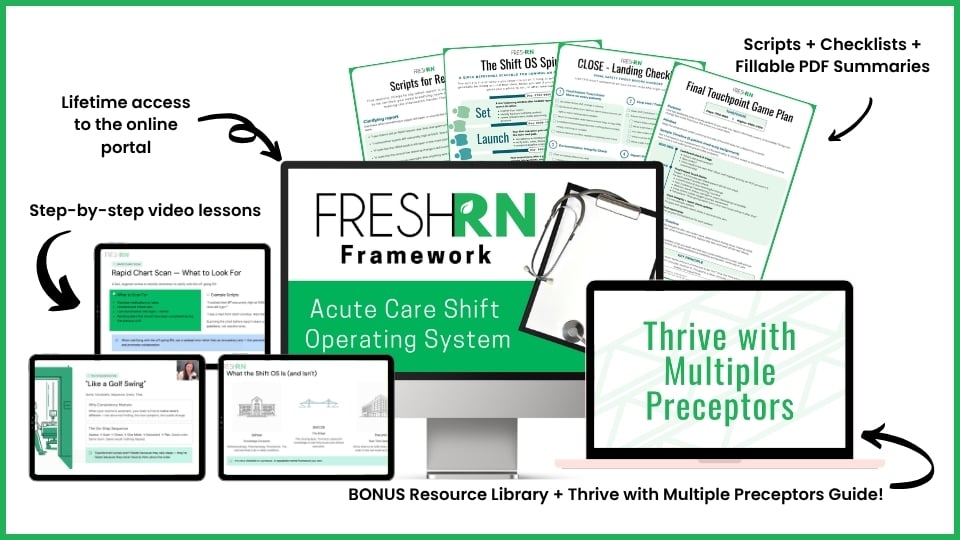
This course helps you turn a messy 12-hour acute care shift into a clear, structured rhythm. You’ll learn how to organize your day after report, prioritize when everything feels urgent, recover when something throws you off track, and give a stronger end-of-shift handoff. No fluff, no vague advice. Just a repeatable system you can use shift after shift. Designed specifically for med-surg, stepdown, and ICU nurses who are tired of feeling behind. No fluff. Just practical training you can use on your very next shift.
See What’s Inside Shift OS →
Remember, even if you’re overwhelmed, try to maintain composure and just do your best. Your ability to provide great care does not depend solely on the report you receive. The chart has a plethora of information to reference if you end up walking away more confused.
Using those acronyms. This enables fast writing, enabling you to pay closer attention. (Quick tip 👉 make a list of ones that you use on your unit all the time and keep it in your phone. Go over it randomly to help committ those unit-specific phrases to memory fast. I promise this pays off!)
Solidify Understanding: Ask, “I’m still learning, what did you mean by____________?” (more on that next!),
Take note of follow-ups in real time: If there are things communicated in report you want to verify in the chart after report is over, put a small star * next to it as a visual reminder to circle back, and open the chart at bedside for confusing orders or needs
Asking Questions
A healthy “don’t be afraid to ask” culture is essential during shift handoff. Clarifying questions show your commitment to understanding the patient’s condition and delivering the safest possible care.
Here’s how to handle questions professionally:
- Don’t hesitate to speak up. If something feels unclear, incomplete, or doesn’t match what you know about the patient’s history or current status, ask right away.
- Let the off-going nurse finish first. Avoid interrupting every few seconds—give them the chance to deliver the full report. Most clarifying questions are best saved until the end. Constant interruptions make report take much longer for everyone.
- Stay curious and respectful. Delivery matters just as much as the question itself. Approach every clarification with humility instead of sounding accusatory.
Helpful Phrases for Asking Clarifying Questions
These simple, humble phrases keep the tone positive and show you’re eager to learn:
- “Forgive me, I’m new. What did you mean by ______?”
- “Okay, what did you mean by _______? I’m still learning the ropes here — sorry if that’s obvious.”
- “Just to make sure I understand correctly, can you tell me a little more about ______?”
- “I want to get this right — could you clarify what you meant by _____?”
Remember: the nurse giving you report has probably been on their feet for 12+ hours. You won’t always get a perfect handoff, and that’s okay. Approaching questions with genuine curiosity and grace builds trust and makes the whole team stronger
Role-Playing Scenarios and Examples
Practical Examples
Here are two scenarios to help you understand how to give nursing report with effective communication during handoff .
Scenario 1: The Med-Surg Patient
Setting: Medical-Surgical Unit Patient: Mr. Harold Jenkins, 68-year-old male in Room 214
Outgoing Nurse (Mary): Hey Sarah, I’m giving you report on Mr. Jenkins in 214.
He’s a 68-year-old male under Dr. Patel on Hospitalist Team A. Code status is full code. Allergies — no known drug allergies.
Precautions: He’s on fall precautions and continuous telemetry because of new-onset atrial fibrillation with RVR.
He was admitted three days ago for acute decompensated heart failure with new atrial fibrillation with rapid ventricular response. He came in pretty volume overloaded: short of breath at rest, 3+ pitting edema to the knees, and BNP was 1,850 on admission. He’s responded really well to IV Lasix; he’s already put out 4.2 liters and his edema is down to 1+.
Pertinent history: He has HFrEF with an EF of 30% from last echo, coronary artery disease with two stents two years ago, hypertension, type 2 diabetes, and CKD stage 3.
Assessment: Lungs have scattered crackles at the bases but much improved from admission. Heart is irregularly irregular at 88–94 today. No JVD noted. Abdomen is soft, non-tender, and he’s had a couple of loose stools. Extremities have 1+ pitting edema now. Skin is warm and dry.
No surgical wounds or incisions. He does have a small stage 2 pressure injury on his sacrum that we’re treating with a foam dressing — it’s clean with minimal serous drainage, changed this morning.
He’s on 2 liters nasal cannula right now — was on 4 liters when he came in. SpO2 has been staying 94–96%.
No tubes. Pulled his Foley on day 1 after he started diuresing and he’s been voiding on his own.
IV access is a 20-gauge in his left antecubital. He has a saline lock right now. No continuous IV fluids or drips running.
Activity: Up with assistance, bed-to-chair. He’s been using the bedside commode because he gets short of breath walking to the bathroom.
Labs to watch: potassium was 3.2 this morning after all the Lasix, so we gave him 40 mEq oral replacement. BUN and creatinine are still a little elevated but trending down. Troponin was negative times three.
Questions for the team: Dr. Patel wants us to ask about starting him on metoprolol for rate control if his heart rate stays above 90. Also, case management needs to know if we think he’ll need home oxygen.
Psychosocially, his wife is here every day but she’s pretty overwhelmed. She mentioned she’s worried about managing his meds and diet at home because he’s been non-compliant in the past. They live alone, and she’s his only caregiver.
Important meds today: he got his carvedilol, lisinopril, metformin, and atorvastatin this morning. He’s still on IV Lasix 40 mg twice a day but we’re hoping to switch him to oral bumex this afternoon. He’s also on apixaban for the new A-fib.
For this shift: We need to get him up to the chair three times and encourage him to use his incentive spirometer 10 times per hour while awake. He also has a swallow evaluation scheduled at 1:00 p.m. because he was coughing with thin liquids yesterday.
Discharge goals: If he stays stable, the plan is to get him home in the next 2–3 days with home health and follow-up with cardiology. We’re working on getting his wife some extra support before discharge.
That’s the big picture — any questions?
Incoming Nurse (Sarah): How much did he actually diurese in the last 12 hours, and has he had any dizziness with the carvedilol?
Mary: Hold on, let me pull it up in chart. I forgot to add it to my sheet. Looks like he put out 1,800 mL in the last 12 hours. No dizziness with the carvedilol, although we have taken our time when standing at the side of bed. Blood pressures have been running 108–118 systolic, which is his normal.
Sarah: Got it. I’ll keep a close eye on his lungs and potassium. Anything else?
Mary: Nope, that’s everything. He’s been pleasant and motivated today.
Scenario 2: The ICU Patient
Setting: Medical Intensive Care Unit (MICU) Patient: Mrs. Elena Vargas, 67-year-old female in Bed 4
Outgoing Nurse (Mary): Hey Sarah, I’m giving you report on Mrs. Vargas in bed 4.
She’s a 67-year-old female under Dr. Thompson with the Pulmonary/Critical Care team. Code status is full code. Allergies: penicillin — she gets a rash.
No precautions.
She was admitted four days ago with severe community-acquired pneumonia. She rapidly decompensated and was intubated yesterday morning for hypoxemic respiratory failure. She also went into septic shock, and we’ve been titrating norepinephrine since last night. She’s starting to stabilize but is still pretty sick.
Pertinent history: COPD on home 2 L oxygen, hypertension, type 2 diabetes, and obesity.
Assessment: She’s currently sedated on propofol at 30 mcg/kg/min. Lungs have coarse breath sounds bilaterally with some wheezing on the right. She’s on the ventilator in assist-control mode. Oxygen/vent: AC rate 12, tidal volume 450 mL, PEEP 8, FiO2 60%, SpO2 staying 94–96%. Heart rate is in the 90s in sinus rhythm on telemetry. Blood pressure is holding at 112/68 on low-dose pressors. Abdomen is soft and non-tender. Extremities are warm with 1+ edema.
No surgical wounds or incisions. Watching her sacrum and has a foam dressing on it right now, just placed about an hour ago.
Tubes: She has a 7.5 endotracheal tube at 23 cm at the lip. Orogastric tube to low intermittent suction with about 150–200 mL of green bile per shift. Foley catheter in place with cloudy yellow urine. Output has been 30–50 mL/hr.
IV access: Triple-lumen central line in the right internal jugular (good waveform) and one peripheral 18-gauge in the left forearm.
Infusions: Norepinephrine at 0.08 mcg/kg/min, propofol at 30 mcg/kg/min, maintenance NS at 75 mL/hr, and heparin drip at 12 units/kg/hr for DVT prophylaxis.
Activity: She’s sedated and bedbound right now.
Labs: White count 18.4, lactate down from 3.8 to 2.1 after fluids and pressors. Creatinine jumped to 2.4 (baseline 1.1) — we’re watching her kidneys closely. Potassium is 5.1. Blood cultures are pending.
Questions for the team: Respiratory therapy wants to do a spontaneous breathing trial this afternoon if she stays stable. We also need ID to weigh in on antibiotic duration, and the team is talking about whether she’ll need home oxygen when she leaves.
Psychosocially: Her husband has been at the bedside most of the day. He’s very involved but anxious and keeps asking about her prognosis. They have three grown kids who are also checking in by phone.
Important meds: She received vancomycin and Zosyn this morning, plus her home lisinopril has been held for now.
This shift: The sepsis protocol is ongoing. We need to keep MAP >65 with as little pressor as possible, continue diuresis if we can, and try a sedation vacation and breathing trial later today. No procedures scheduled right now.
Discharge goals: If she keeps improving, the plan is to extubate in the next 24–48 hours and eventually step down to the floor. We’re also starting to talk about rehab needs.
That’s the big picture. Any questions before I head out?
Incoming Nurse (Sarah): Thanks Mary. Did she get a bath today and any bowel movements?
Mary: No, she’ll need one this shift. No BMs. Unsure of when the last one was, as it was prior to admission and husband didn’t know. Bowel sounds are present and technically normal but I could see them getting hypoactive soon.
Sarah: Ok thanks.
Sample ED Nurse to Nurse Report
If you’d like to hear a real ED RN give a report, watch the video below!
Mastering Nursing Report Takes Practice, But You’ve Definitely Got This
Giving a clear, organized, and professional nursing report is one of the most important skills you’ll develop as a nurse. Whether you’re a new grad on your first med-surg rotation or an experienced nurse stepping into ICU, using a consistent structure, a good report sheet, and the right communication habits will make shift handoffs faster, safer, and less stressful for everyone.
The best way to get better quickly is to practice the same format every single shift and use a reliable brain sheet. That’s exactly why I created my free nursing report mini master email course. it walks you through the entire process with daily lessons, examples, and cheat sheets so you can go from nervous to confident in less than a week.
Ready to stop stressing about report? Enter your email below to get Lesson 1 instantly + my Med-Surg nursing report sheet as a free bonus.
You’ve already taken the hardest step by reading this far. Keep practicing, stay curious, and you’ll be the nurse everyone wants to receive report from in no time.


0 Comments