
This is a guest blog post written by fellow nurse, Kristine Shepherd, MSN, RN
Thinking about medication safety is one of those things nurse leaders don’t really get to turn off. Even on days when nothing obvious goes wrong, the “what ifs” still follow you as you’re driving home and catch yourself reflecting on your day. You wonder if the evening shift ended up shorter than planned, or if someone stayed late to finish a medication pass. You replay a conversation from earlier in the week about a near miss and think, “Did we actually fix that, or did we just move on because the unit was busy?”
After years at the bedside, in leadership, and now working with healthcare organizations on medication workflows, my view of medication safety has shifted. It’s not really about telling nurses to slow down or be more careful. Most of the time, they’re already doing that, and carrying more than anyone realizes. When medication safety breaks down, very rarely is it about carelessness. It’s usually a sign that the system couldn’t support the reality of the shift. And along the way, it’s impossible for nurses to forget that medication errors have real consequences.
Table of Contents
Medication Errors Rarely Start Where We Think They Do
When a medication error happens, the focus almost immediately lands on the nurse who administered the medication. On the surface, that may make sense. It’s the most visible part of the process. But when you slow down and trace the events leading up to most errors, the problem usually started well before the medication ever reached (or didn’t reach) the patient.
I’ve watched a nurse give a medication late, not because she forgot or didn’t care, but because the medication wasn’t in the cabinet when she went to get it. She stepped away to answer a call light, then a phone call from pharmacy, then a family member’s question. By the time she returned to her original task, the rhythm of her workflow had already fallen apart due to the weight of too many tasks, too few hands, and endless competing demands.
In one situation, a nurse skipped a safety step. And it wasn’t because she didn’t know it mattered. She had two high-acuity patients, and she was trying to help a new nurse at the same time. The phone rang. The call light went off. Someone asked her for help. It was just too much at once. And by the time she got back to the process, it didn’t even look like the policy anymore. But the policy hadn’t changed. The workload had, and that distinction matters.
When leaders stop the conversation at “the nurse made a mistake,” we miss the chance to fix what actually created the risk in the first place. And just as importantly, we send a message, whether we intend to or not, that speaking up may not be safe.
Staying Close to the Work Changes the Conversation
Some of the most valuable insights about medication safety come from simply being present on the unit.
I remember watching a nurse during a medication pass. She kept getting interrupted, over and over in just a few minutes. A call light went off. Then the phone from pharmacy rang. Any one of those interruptions would have been fine. But all together, it made it almost impossible to focus. What stuck with me wasn’t how many times it happened. It was how normal it all felt.
Leaders who take time to observe workflows, not to audit or correct, but to understand, start to see where risk quietly lives. You notice where nurses hesitate, where they backtrack, where they’ve built workarounds just to keep the shift moving. Those are the moments that lead to better questions. Why does this specific drawer always cause confusion? Why does this medication require so many extra steps? Why are nurses regularly leaving the bedside to track something down?
Those answers rarely show up in formal metrics, but they matter.
Coaching After an Error Is a Leadership Test
Sitting down with a nurse after a medication error is one of the hardest parts of leadership. By then, they are already carrying fear, shame, and worry about causing harm to their patient, their license, their job, and the team depending on them. When leaders start with policy violations or documentation issues, the conversation can shut down before it even begins. What should be a moment to learn and support quickly feels like judgment, leaving both sides tense and unsure.
More productive conversations start with understanding. What was happening that day? How many patients were you covering? What interruptions occurred? Was anything missing or unclear? When leaders approach these conversations with curiosity instead of blame, nurses are more willing to be open about what happened and that is what allows leaders to see patterns that won’t appear in incident reports alone.
Where Policy and Reality Collide
Every nurse leader knows the tension between compliance and practice. Policies are written for consistency, but nursing is practiced in complexity. I’ve worked on units where medication policies required multiple verification steps that made sense on paper but were difficult to complete in practice without leaving the bedside repeatedly or navigating multiple systems.
What happened over time was predictable. Nurses found ways around the process so they could get through the shift. This wasn’t because they were careless, but because the workflow just didn’t fit the environment.
When leaders respond to repeated “noncompliance” with discipline alone, the behavior usually doesn’t stop. It just becomes less visible. But when leaders treat it as a signal that something isn’t working, they have the opportunity to advocate for meaningful change.
Sometimes that means revisiting workflows with the pharmacy team. Sometimes it means reorganizing how medications are stored or acknowledging that a policy needs to be updated because it no longer reflects how care is delivered. Policies should support safe practice. They shouldn’t compete with it.
Medication Safety Is Shared, Even When It Doesn’t Feel That Way
Nurses can feel like medication safety is all on them, and some days it really does seem that way. But the reality is that it’s shared. It only works when nursing, pharmacy, leadership, and operations all pull in the same direction. When pharmacy has a clear picture of inventory and restocking, the difference is huge. Nurses spend less time running around and there are fewer delays and workarounds just to get meds to patients on time.
When those workflows are actually aligned, nurses can spend more time at the bedside and perform more thorough assessments, often leading to better conversations with patients and fewer rushed decisions. Leadership can make or break that alignment. When teams handle problems together instead of separately, nurses feel supported and patient care runs more smoothly.
Preparing Teams for What Comes Next
Medication management is always changing as new technology is implemented, staff come and go, and workflows shift over time. One thing I’ve learned is that being honest with your team matters more than any checklist. Let nurses know what’s coming, explain why it’s happening, and then listen to what they have to say. I’ve seen teams completely check out when their input disappears into nothing.
Medication safety doesn’t live in policies alone or in asking nurses to try harder. It lives in understanding what a real shift looks like and building systems that support it. When leaders stay close to the work, listen to the people doing it, and respond to what they see, safety becomes something teams create together, not something nurses carry alone. That’s when workflows start to make sense, trust grows, and small problems are addressed before they become harmful. This is how safer care happens, one supported shift at a time.

Kristine Shepherd, MSN, RN joined Omnicell in 2016. With more than twenty-five years of clinical and management experience in nursing, Ms. Shepherd brings a wealth of unique clinical experience as well as an ability to foster collaborative relationships while providing expertise in process improvement and safety, ultimately increasing the efficiency of health care delivery. Ms. Shepherd has a passion for research, education, utilizing best practices within the nursing profession, and compliance with regulatory requirements – providing essential resources for our healthcare partners.
Prior to joining Omnicell, Ms. Shepherd served as a Director of Nursing for the New Mexico Department of Health, Public Health Division, providing expertise and consultation to healthcare partners concerning infectious diseases, policy and practice improvement, with consideration of state and federal regulatory recommendations. Ms. Shepherd holds a Master of Science in Nursing Leadership and Management from The George Washington University.

Don’t be intimidated! Follow these tips for working with physicians and banish your nursing anxiety for good.
Continue Reading Working With Physicians: 8 Tips Every New Nurse Should Know

People pleasing in nursing leads to perfectionism, burnout, and anxiety. Learn how to break the cycle and build a more confident, compassionate identity.
Continue Reading People Pleasing in Nursing: How Perfectionism Leads to Burnout

Wondering if your preceptor is just tough, or actually toxic? Here’s how to spot the red flags of bullying, protect your mental space, and navigate this tricky dynamic like a pro nurse (without losing your mind).
Continue Reading Is Your Preceptor a Bully? Here’s How to Tell and What to Do

If you have to write out goals for nursing evaluations during your performance review process, I go over a few great ideas and ways you can structure yours!
Continue Reading 32 Powerful Goals for Nursing Evaluations to Help You Succeed

Practical ICU communication tips for new nurses: learn how to ask questions, speak up, and work with your team during your first months in critical care.
Continue Reading ICU Communication Tips for New Nurses: Working With Your Team

Cardiac nursing is very rewarding. Just when you think you’ve got it figured out, you’ll find something new. Let’s look at a Cardiac Nurse typical day.
Continue Reading Cardiac Nurse Responsibilities: A Typical Day on the Unit
Wish Your 12-Hour Shift Had A Map?👇
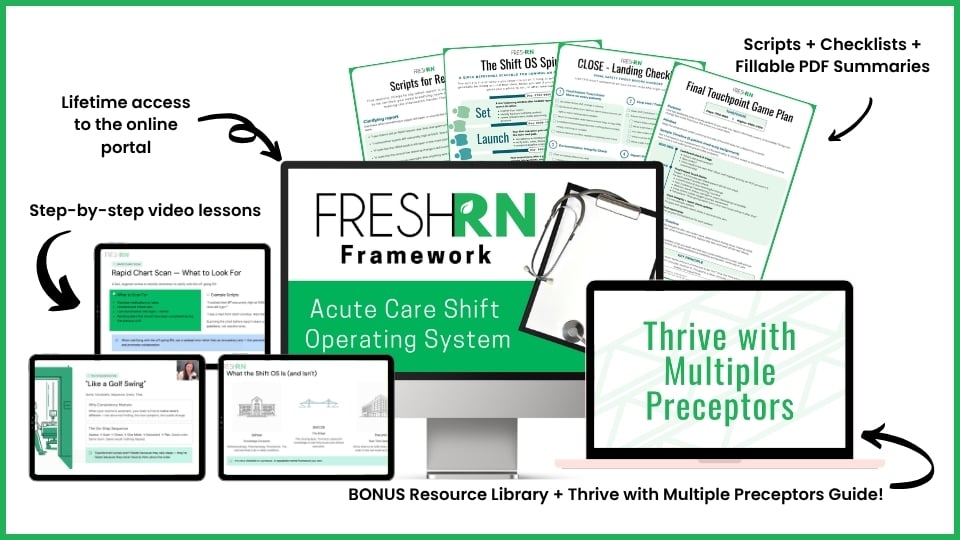
Turn a chaotic 12-hour acute care shift into a clear, structured rhythm. We cover: how to launch after report, prioritize when everything feels urgent, and finish with a clean handoff.
See What’s Inside Shift OS →

0 Comments