
If you’re a nursing student, one of the first things you’ll notice during clinicals is that your patient’s MAR (Medication Administration Record) can look… well, overwhelming. It’s not just a single tidy list, it’s split into categories, and the two biggest categories are:
- Scheduled meds
- PRN meds
You’ll spend the majority of your time in these tabs. So let’s break down the differences between the two (with some tips sprinkled in!) so you can walk into your shift feeling prepared.
💊 Scheduled meds
Scheduled meds have a specific due time and are meant to be given on, well… schedule.
But, it’s not always as simple as “the clock says it’s time.” Some scheduled medications have what’s called holding parameters. This means you would hold (or not give) the medication if these parameters are met.
Cardiac medications are the most frequent meds with parameters. For example:
- Hold for HR < 60 (hold for a heart rate less than 60)
- Hold for SBP < 90 (hold for a systolic blood pressure less than 90)
Your rule of thumb: For scheduled meds, you either administer the med, or document why you didn’t (with a clear, valid reason).
💊 PRN meds
PRN means “as needed,” which gives you flexibility, within limits. These meds save you from calling the provider every time your patient needs/requests something small like:
- Acetaminophen for a mild fever
- Pain meds for breakthrough pain
- Stool softeners for constipation
- BP meds for a mildly elevated result
They’re a wonderful time saver and expedite patient care. The catch? You can’t just give them whenever you want. Every PRN order must have an indication, which means you can only administer them for the specific indication listed, otherwise you’re practicing outside of your scope.
Example: Let’s say you have a patient who as a PRN lorazepam ordered for seizures lasting longer than 2 minutes, but you decide to give it for anxiety. That’s inappropriate. If the patient is so anxious they need lorazepam and the patient has a history of seizures, the physician should be notified and an appropriate order for that specific indication should be placed.
🚑 Quick takeaways for students
- Always check holding parameters before giving a scheduled med.
- For PRNs, read the indication every time. If it doesn’t match your patient’s current need, call the provider for a new order.
- Document clearly whether you administered (or why you held) the med.
🧰 More Resources on meds for nursing students
- This is just scratching the surface of med management. If you’re a student, check out this full post on: Medication Administration for Nurses & Nursing Students
- If you’re already on the floor and want to master meds in real-time, my Med-Surg Nurse Crash Course is made just for you.
Until next time,
Kati 🪴

Don’t be intimidated! Follow these tips for working with physicians and banish your nursing anxiety for good.
Continue Reading Working With Physicians: 8 Tips Every New Nurse Should Know

People pleasing in nursing leads to perfectionism, burnout, and anxiety. Learn how to break the cycle and build a more confident, compassionate identity.
Continue Reading People Pleasing in Nursing: How Perfectionism Leads to Burnout

Wondering if your preceptor is just tough, or actually toxic? Here’s how to spot the red flags of bullying, protect your mental space, and navigate this tricky dynamic like a pro nurse (without losing your mind).
Continue Reading Is Your Preceptor a Bully? Here’s How to Tell and What to Do

If you have to write out goals for nursing evaluations during your performance review process, I go over a few great ideas and ways you can structure yours!
Continue Reading 32 Powerful Goals for Nursing Evaluations to Help You Succeed

Practical ICU communication tips for new nurses: learn how to ask questions, speak up, and work with your team during your first months in critical care.
Continue Reading ICU Communication Tips for New Nurses: Working With Your Team

Cardiac nursing is very rewarding. Just when you think you’ve got it figured out, you’ll find something new. Let’s look at a Cardiac Nurse typical day.
Continue Reading Cardiac Nurse Responsibilities: A Typical Day on the Unit
Wish Your 12-Hour Shift Had A Map?👇
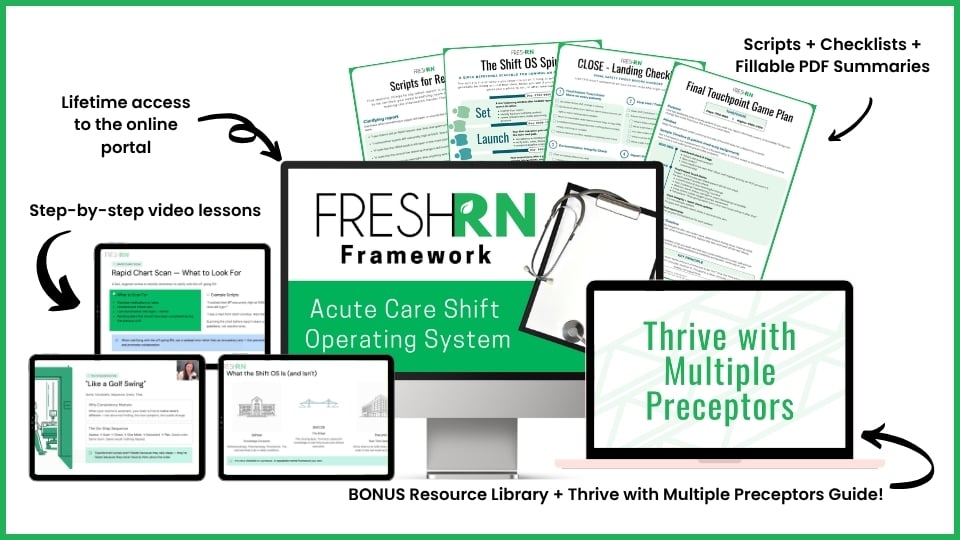
Turn a chaotic 12-hour acute care shift into a clear, structured rhythm. We cover: how to launch after report, prioritize when everything feels urgent, and finish with a clean handoff.
See What’s Inside Shift OS →

0 Comments