
It’s 0620. Night shift is almost over, you’re about to give report in 45 minutes, and you’re dreaming of heading home and faceplanting into your pillow… when the lab calls.
Your patient had a cardiac cath yesterday around 1600. A CBC and BMP were drawn at 0400 to follow up. The results just posted, but the potassium came back at an alert level of 2.7.
Here’s what makes it tricky:
- The cardiologist ordered the CBC.
- The hospitalist (and the attending physician) ordered the BMP.
- The potassium was part of the BMP, but you know the cardiologist would definitely care about that level.
- The patient normally takes furosemide for their heart failure and has a dose due at 0900.
Because it’s an alert lab value, policy says you need to call and notify a provider within 30 minutes and document that notification within that time frame in the patient’s chart.
Oh, and did I mention it’s about to be shift change for the nursing staff, and the doctors’ call at your hospital ends at 0700 too.
So… who do you call?
Cardiology? Hospitalist? The attending?
Here’s the reality: it depends
All throughout nursing school, we’re told, “Notify the physician, notify the physician”… but what if there are five different physicians on the chart?
What if you call one physician, and he tells you to call another physician, who then tells you to call another physician?
What if it’s in the middle of the night and you’re not sure if you’re waking someone up or not?
**P.S.**💡 If you’ve ever wondered what being on call or post-call means… or how physician schedules work in general, check out this blog post.
How doctors share responsibilities
A lot of the confusion comes down to how physicians share responsibilities:
- Attending physician: Usually responsible for the overall plan of care and often the “final say.”
- Consulting specialists (like cardiology): Manage issues specific to their specialty, but only when consulted or related to their scope.
- Hospitalist: Oversees day-to-day care for admitted patients, unless the attending is directly involved.
So in this case? To answer the actual question about which doc to call, I’d probably call the attending. But, I’m 98.2% sure he or she would tell me to notify cardiology and have them deal with it!
Final thoughts
The truth is, knowing this isn’t a skill you perfect overnight. The more you see, the better you’ll get at making judgment calls. For now, your best bet is:
- Know the chain of command on your unit.
- Always check the orders before you call.
- When in doubt, start with the attending or hospitalist, and document who you called and when.
Because at the end of the day, the patient’s safety (and your license!) depends on that timely notification.
Until next time,
Kati 🪴
📌 Want to feel more confident in these kind of moments?
- Listen to this podcast episode where we give 8 tips for working with providers for nurses.
- Check out this full post on How Doctor Schedules Work (for the most part).
- And if you’re a brand new nurse you’ll love the New Nurse Master Class, where we walk through various real-world scenarios, just like this one.

Don’t be intimidated! Follow these tips for working with physicians and banish your nursing anxiety for good.
Continue Reading Working With Physicians: 8 Tips Every New Nurse Should Know

People pleasing in nursing leads to perfectionism, burnout, and anxiety. Learn how to break the cycle and build a more confident, compassionate identity.
Continue Reading People Pleasing in Nursing: How Perfectionism Leads to Burnout

Wondering if your preceptor is just tough, or actually toxic? Here’s how to spot the red flags of bullying, protect your mental space, and navigate this tricky dynamic like a pro nurse (without losing your mind).
Continue Reading Is Your Preceptor a Bully? Here’s How to Tell and What to Do

If you have to write out goals for nursing evaluations during your performance review process, I go over a few great ideas and ways you can structure yours!
Continue Reading 32 Powerful Goals for Nursing Evaluations to Help You Succeed
Practical ICU communication tips for new nurses: learn how to ask questions, speak up, and work with your team during your first months in critical care.
Continue Reading ICU Communication Tips for New Nurses: Working With Your Team

Cardiac nursing is very rewarding. Just when you think you’ve got it figured out, you’ll find something new. Let’s look at a Cardiac Nurse typical day.
Continue Reading Cardiac Nurse Responsibilities: A Typical Day on the Unit
Wish Your 12-Hour Shift Had A Map?👇
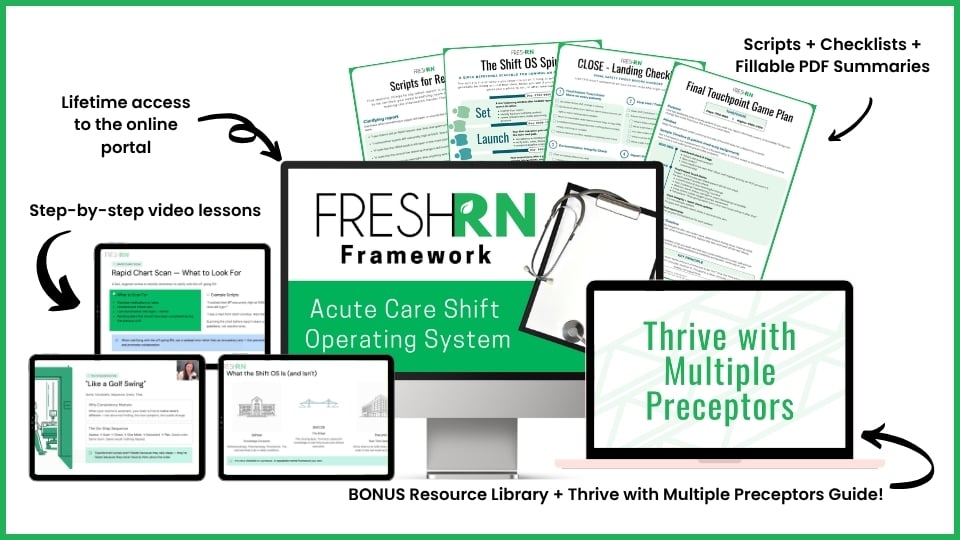
Turn a chaotic 12-hour acute care shift into a clear, structured rhythm. We cover: how to launch after report, prioritize when everything feels urgent, and finish with a clean handoff.
See What’s Inside Shift OS →

0 Comments