
When most nurses hear “AI,” the first reaction usually isn’t, “Yay, can’t wait!” 🙃
It’s more like:
- Is AI going to replace nurses?
- Is this just another thing that makes my job harder?
- Who is deciding how this is used, and is anyone asking nurses for our opinion?
In this episode of The FreshRN Podcast, I sat down with Dr. Susan Grant, DNP, RN, NEA-BC, FAAN, Chief Clinical Officer at symplr and a nationally recognized nursing leader, to talk honestly about AI in nursing practice: what it is actually good for, how it can reduce administrative burden, and what leaders can do to build trust instead of fear.
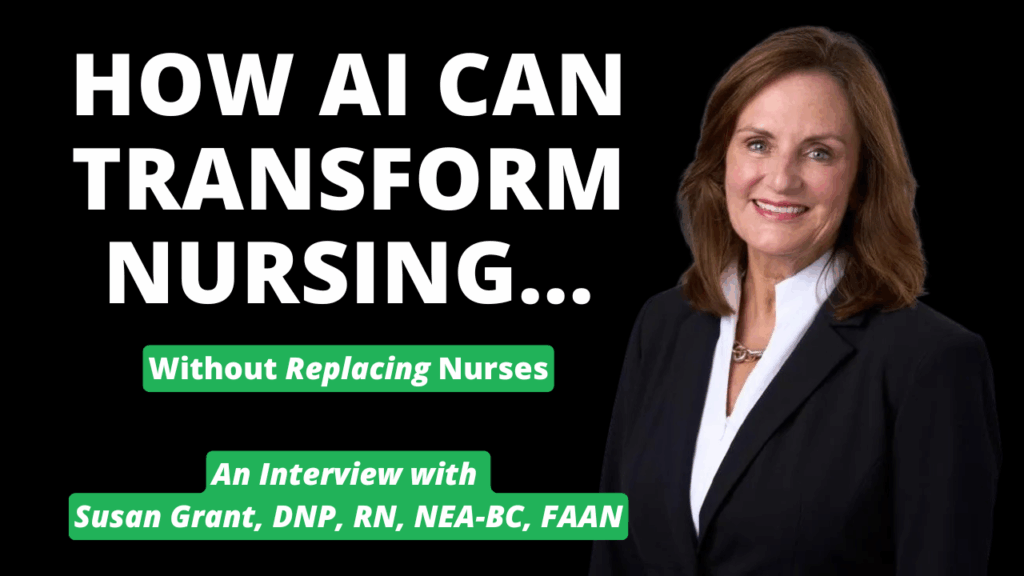
You can listen to the full conversation here 👇
Below, I highlight some of the key insights we talk about for bedside nurses, educators, and nurse leaders who are trying to figure out how artificial intelligence in nursing can support care, not replace it.
Table of Contents
First Things First: Will AI Replace Nurses?
Short answer: No.
The honest (and sometimes frustrating) truth is that there are plenty of roles in healthcare and industry that could become partially or fully automated due to AI. But as Dr. Grant shared, nursing isn’t one of them, and here’s why:
- Nursing is built on critical thinking, not just task completion.
- We make nuanced decisions based on overlapping conditions, trajectories, and patient/family context.
- We provide human connection: the kind where you see fear in a patient’s eyes, pick up subtle changes long before a score does, or offer the exact words someone needs to hear in that moment.
AI in nursing practice can’t replace that. What it can do is handle pieces of the job that don’t require a nurse’s brain or heart, so we can spend more time on the things that absolutely do.
Instead of asking, “What will AI take away from nurses?”, a better question is ⬇️
“What should AI take off our plates so we can fully show up for patients?”
How AI Can Support Nurse Managers (Without Replacing Them)
If you’ve ever watched a nurse manager glued to a computer instead of rounding on the unit, you know how much admin work pulls them away from their teams. Schedulers. Licensure tracking. Mandatory education. CMS prep. Joint Commission checklists. Staffing grids. Turnover reports. Patient experience dashboards. 🫠
Dr. Grant pointed out something important:
The last thing a nurse manager with a master’s degree and decades of experience should be doing all day is wrestling with spreadsheets.
AI in nursing leadership can step in here! Especially for:
- Predictive scheduling and staffing, so managers can quickly see where gaps will be before they become crises.
- Automated certification and licensure tracking, with reminders and reporting handled by the system instead of with a human-made spreadsheet.
- Regulatory and compliance monitoring, surfacing what truly needs attention instead of forcing leaders to hunt through multiple systems.
None of that requires the advanced clinical judgment of a nurse leader. But that time freed up can absolutely be used to:
- Round on staff
- Coach new nurses
- Address burnout and morale
- Work on quality and safety initiatives
That’s the kind of AI in nursing practice we want more of: the kind that gives leaders their time and presence back.
AI Can Capture the “Invisible” Work of Nursing
Kati: “[Having to] type everything that you did is just so exhausting. And then honestly, at some point you’re just like, I honestly don’t want to do more things, because then I have to type more things.”
Nurses are constantly being asked to chart more: checklists, flowsheets, quality measures, narrative notes. But no one is giving us more time in the 12-hour shift to do it. One of the most exciting areas of AI in nursing right now is ambient listening technology: systems that can capture a nurse-patient interaction and automatically generate documentation for review.
Dr. Grant shared a powerful example:
A nurse was preparing a patient for an unexpected trip back to the OR. After finishing all the clinical tasks, she paused and asked, ‘Is there anything else you need before you go?’
The patient said, ‘Yes. Can you pray with me?’
The nurse stopped, held space, and prayed with the patient.
Ambient listening captured that moment and generated documentation that the patient’s spiritual needs were identified and addressed.
That’s something most of us would never chart, but it’s the heart of what we do, and it’s incredibly valuable!
AI didn’t do the compassionate act. But AI in nursing helped ensure that act was seen, valued, and recorded. Over time, technology like this can:
- Reveal more clearly the real emotional and spiritual labor nurses provide
- Help us articulate the value of nursing in ways we’ve struggled to quantify
- Make documentation feel less like a burden and more like a reflection of the whole care we give
Why Nurses Don’t Trust Tech (And Why That’s Fair)
If you’re skeptical about AI in healthcare, you’re not being “negative”, you’re being realistic.
Historically, a lot of tech has been:
- Rolled out without bedside nurse input
- Designed around billing or compliance, not workflow
- Launched half-baked, with nurses stuck “working out the bugs” in real time
Dr. Grant shared a story about an AI-powered deterioration prediction tool that was “turned on” in the EHR without nurses being informed or trained. It started generating data that made it look like nurses weren’t intervening early enough, when in reality, they just didn’t know how the system worked or what to do with the alerts.
That’s not an AI problem, that’s a governance and communication problem.
She also shared an example of implementing iPhones for clinical communication, then later tying bed management alerts into the same device. Bed alerts ended up overriding clinical messages, delaying nurse-physician communication. The nurses were the ones who saw the risk. These kind of stories explain exactly why trust is low.
Building Trust: Nurses at the Center of AI
So what does build trust?
Dr. Grant was very clear:
Nurses must be involved from the very beginning in how AI is chosen, designed, tested, and rolled out.
That means:
- Strong partnerships between the Chief Nursing Officer (CNO) and CIO
- Shared governance councils that include bedside nurses, nurse managers, informatics, physicians, pharmacy, IT, and others
- Clear, early education about what a tool does, and what it does not do
- Fast response when nurses identify safety issues or workflow barriers
When nurses help design AI in nursing practice, it stops being “something done to us” and becomes “something we’re using to make care better.” And that’s a huge mindset shift.
A Win: When AI Makes a Nurse Look Good
AI wins trust when nurses feel like it actually helps them shine.✨
➡️ Story Time: Dr. Grant told a story about a unit using a tool that pulls in relevant patient information (from current and past admissions) into a quick snapshot.
A nurse walked into a room and said:
“Hi, Mrs. Brown. I see you were here with us three months ago. I’m so sorry you’re back.”
Then added:
“I also see your discharge was delayed last time. We’re going to do everything we can to make sure that doesn’t happen again.”
The patient was stunned, in a good way. She felt known and remembered.
Later, the nurse told her manager:
“That tool made me look really good.”
And that right there is the point. AI in nursing practice should:
- Help newer nurses feel more confident
- Make it easier to build rapport quickly
- Reduce patient anxiety because staff seem organized, informed, and on top of things
Preparing New Nurses for an AI-Driven Workplace
Here’s the tricky part: many of the nurses precepting new grads are also still learning how to use AI and new tech tools. We’re all building the plane while we’re flying it. So how do we prepare new nurses for AI in nursing practice without overwhelming them? Dr. Grant suggested a few key directions:
1. Build AI literacy for current nurses and faculty
We can’t expect new grads to be comfortable with AI if their preceptors and professors feel completely lost. This is where:
- Health systems
- Schools of nursing
- Industry partners (like symplr)
…need to collaborate on education and exposure.
2. Use academic-practice partnerships
Dr. Grant shared an example of a doctoral nursing student at UNC Wilmington working directly with symplr as part of her project: learning the tech side and bringing that back into teaching and leadership. That’s exactly the kind of nurse led AI work we need more of.
3. Simulate the whole reality of nursing, not just the clinical skills
Some schools are starting to build “simulation hospitals” that don’t just practice assessments and codes, but also:
- Scheduling and staffing issues
- Supply chain and equipment availability
- Quality and safety processes
- Documentation and compliance tasks
Why? Because that’s the world new nurses are stepping into. And AI in nursing is likely to show up first in those non-clinical workflows, the stuff that currently eats 88 minutes per day of a clinician’s time on average (per symplr’s survey).
The more realistic we can make transition to practice, the less shocking it is, and the easier it is to show how AI can relieve some of that hidden load.
A Glimpse 5-10 Years Into the Future
We ended our conversation by looking ahead. If we do this well, here’s what Dr. Grant hopes nurses will be able to say in 5-10 years about AI in nursing practice:
“I have time to do what only a nurse can do. I work at the top of my license. I bring the best of nursing to every patient I care for.”
💭 Imagine:
- Administrative and scheduling tasks largely automated
- Documentation heavily supported by ambient listening and smart prompts
- AI-powered tools flagging subtle trends so we can intervene earlier
- Fewer codes, shorter hospital stays, and better patient outcomes
- Nurse managers leading people, not just managing checklists
➡️ That future only happens if nurses are leading the conversation, not just reacting to it.
Final Thoughts: Owning the Future of AI in Nursing Practice
Nurses are fiercely protective of their patients, and that’s a good thing. Skepticism about AI in healthcare doesn’t mean we’re “anti-tech.” It means we’ve lived through clunky rollouts, safety issues, and systems that created more work instead of less.
But if we own how AI in nursing practice is designed and used, everything changes.
- We can push for tools that reduce burnout instead of adding to it.
- We can protect space for human connection and hands-on care.
- We can help shape tech that supports our judgment instead of undermining it.
AI will never replace the heart of nursing. But if we lead the way, it can absolutely help us protect it. 🌱
🧰 More Resources on AI in Nursing Practice
- Connect with Dr. Susan Grant and symplr: https://www.symplr.com
- Blog Post: What AI in Nursing Actually Looks Like (Hint: It’s Already Here)
- Blog Post: AI and Nursing Education: Trends, Tools, and the Future of Learning
- For Nurse Leaders: Check out FreshRN Enterprise for comprehensive, plug-and-play residency programs for your new grads and early-career nurses

Don’t be intimidated! Follow these tips for working with physicians and banish your nursing anxiety for good.
Continue Reading Working With Physicians: 8 Tips Every New Nurse Should Know
People pleasing in nursing leads to perfectionism, burnout, and anxiety. Learn how to break the cycle and build a more confident, compassionate identity.
Continue Reading People Pleasing in Nursing: How Perfectionism Leads to Burnout
Wondering if your preceptor is just tough, or actually toxic? Here’s how to spot the red flags of bullying, protect your mental space, and navigate this tricky dynamic like a pro nurse (without losing your mind).
Continue Reading Is Your Preceptor a Bully? Here’s How to Tell and What to Do
If you have to write out goals for nursing evaluations during your performance review process, I go over a few great ideas and ways you can structure yours!
Continue Reading 32 Powerful Goals for Nursing Evaluations to Help You Succeed
Practical ICU communication tips for new nurses: learn how to ask questions, speak up, and work with your team during your first months in critical care.
Continue Reading ICU Communication Tips for New Nurses: Working With Your Team

Cardiac nursing is very rewarding. Just when you think you’ve got it figured out, you’ll find something new. Let’s look at a Cardiac Nurse typical day.
Continue Reading Cardiac Nurse Responsibilities: A Typical Day on the Unit
Ready to think like the nurse everyone trusts?

You’re a good nurse, but you want to be a great one. Critical Thinking for Nurses teaches you how to notice subtle changes, make smarter decisions under pressure, and earn the respect of coworkers and providers alike (even that kinda intimidating one 👀).
See What’s Inside Critical Thinking →

0 Comments