
There’s a very specific kind of nursing misery that happens when you’re capable in the ICU… but emotionally tapped out by it. You can handle the drips and the vents, but the suffering, the death, and the constant edge-of-your-seat unpredictability is draining the life out of you.
And then you start thinking: “Could I still become a CRNA… even if I don’t love ICU?”
In this FreshRN Podcast episode, I talked with Jenny Finnell, MSN, CRNA (12+ years in anesthesia) who said something that a lot of nurses need to hear: You don’t have to love ICU to become a CRNA, or to thrive once you’re there.
Jenny started in an adult MICU, now works in pediatric anesthesia, and she breaks down how to get into CRNA school, and what that actually looks like: the requirements, the application “gotchas,” the interview intensity, and what matters more than people think (hello, emotional intelligence).
Listen to the full episode here 👇
Table of Contents
You can hate the ICU and still be a great CRNA
Jenny was really honest about her experience: she did fine with the clinical complexity, but the emotional toll of the ICU was heavy. As a CRNA, she describes the emotional landscape differently. Most cases are planned, controlled, and predictable, yet you still need the skills to respond fast when things go sideways.
She put it like this: anesthesia is a bit like flying a plane. Takeoff and landing are the riskiest parts. In the middle, things are usually steady, unless turbulence hits (often driven by what’s happening surgically). So if ICU feels like nonstop chaos and moral distress, CRNA work can feel like a different world… without losing the parts of critical care you’re good at, and enjoy.
How to get into CRNA school: the “minimums” (and the nuances that matter)
If you’re googling how to get into CRNA school, here’s the basic truth: most programs want ICU experience, but the details vary more than people realize.
Jenny’s biggest advice: start researching early. Even if you don’t know what schools you’ll apply to yet, you need to learn the patterns and the exceptions.
ICU experience for CRNA school
Many programs require at least 1 year of ICU experience. Some require 2 years. Some will consider NICU/PICU/ER “on an individual basis,” which often means: we’ll look, but it’s not preferred.
Also (this is a big one) some schools may not count months spent in orientation/residency toward the “one year” requirement. So your “one year” may need to be one year independent practice, depending on the program.
What about PICU or NICU?
Jenny shared that PICU is more commonly accepted than NICU, because anesthesia is mostly adults (with peds mixed in depending on setting), and NICU is a very niche population. That said, if a school explicitly welcomes PICU applicants, you can absolutely pursue it, just know you’ll still be expected to understand adult patho/pharm.
[icu opt in]
CRNA prerequisites: don’t get blindsided by old science credits
This part trips people up all the time.
Many CRNA programs have “recency” requirements for core sciences, often within the last 10 years. Core sciences may include things like:
- anatomy & physiology
- biology
- pathophysiology
- chemistry
- math/statistics
And CRNA prerequisites can be more demanding than what your BSN required. For example, some programs require two chemistry courses (Chem 1 + Chem 2 OR Chem 1 + O-Chem [organic chemistry]), and some require graduate level statistics.
Jenny’s point was practical: if your undergrad sciences are old, sometimes the best move isn’t retaking undergrad A&P, it may be taking a graduate-level pathophysiology/anatomy course to show you can handle the rigor now.
The CRNA application timeline: give yourself at least 6 months (minimum)
If you’re serious about how to get into CRNA school, give yourself runway. Jenny recommends at least six months, because the “paperwork” isn’t the hard part, the planning is.
Things that take time:
- lining up strong references (and rebuilding relationships if you’ve been out of school)
- filling prerequisite gaps
- building leadership experience (more on that below)
- tightening your resume and personal statement
Leadership experience counts (and it doesn’t have to be fancy)
CRNA programs want evidence you can grow, contribute, and function under pressure.
Leadership can include:
- precepting
- charge nurse shifts
- unit-based councils/committees
- involvement in professional organizations (like AACN)
- leadership/community service outside work (food bank, church, volunteer orgs)
The key is choosing something you actually care about, because if they ask about it, your answer needs to sound real.
Your resume is being scanned, not studied
Jenny said something nurses need to remember:
You’re applying to grad school, not a job, so lead with education and keep your experience easy to skim.
A few resume realities:
- people scan fast
- formatting matters more than you think
- “fluff bullets” are obvious
- errors can quietly sink you
Her advice was simple and solid: have another human review it. AI can help with clarity and structure, but you still need real eyeballs to catch weird typos or flow and ensure it’s readable.
➡️ (And yes, she specifically said: do not let AI write your personal statement for you. Use it like a smart editor, not a ghostwriter.)
CRNA school interviews: why nurses struggle (and how to prepare)
A CRNA interview is not like a typical “tell me about yourself” conversation. It can be pretty intense, and it can vary wildly by program.
Jenny described two common interview styles:
1) Rapid-fire clinical questioning
This is the “you don’t even finish answering before they ask the next question” format. Questions can include:
- vasoactive drips
- ICU scenarios tied to your unit type (CVICU tends to get more cardiac questions)
- head-math dosing questions (no calculator)
- random physiology/pharm basics
2) Emotional intelligence and behavior-based questions
These can include:
- conflict with a colleague and how you handled it
- how you receive feedback
- what coworkers would say you need to improve on
- why CRNA, why now, why you
Jenny made a point I loved: emotional intelligence is developable. And honestly? It matters a lot for surviving CRNA school because it affects communication, resilience, and your ability to function in high-stress clinical environments.
The best interview prep is boring (and it works)
If you take one thing from Jenny’s interview advice, take this: Practice out loud.
Not to sound rehearsed, but to build “muscle memory,” the same way you do ACLS training, so that when you need it you can actually function under the stress, and let the muscle memory take over. When you get nervous, your brain gets loud and your words disappear. Speaking practice fixes that.
What if you don’t know an answer?
You will get asked something you don’t know. Jenny remembers being asked where platelets are made and answering incorrectly (we’ve all had a moment like that).
Her strategy: don’t panic, own it and pivot. Try: “I’m not sure about that specific detail, but here’s what I do know…” Then share related knowledge to show your thinking and foundation. That gives them something to evaluate besides “I don’t know” on repeat.
How competitive is CRNA school, really?
Jenny cited an acceptance rate in the ballpark of 12-15%, meaning most applicants are rejected. So if you don’t get in the first time, it doesn’t mean you’re incapable. It means you need a plan.
A few important nuances she shared:
- some programs limit how many times you can apply/interview
- some programs like reapplicants if they show growth
- reapplying with the exact same application signals you didn’t learn anything
Reapplying can be powerful if you can clearly answer: what did I do differently this year?
Online CRNA programs and clinical travel: what’s actually realistic?
The clinical portion of CRNA education is always in-person, with strict case-number requirements.
Didactic coursework may be:
- in-person
- hybrid
- online (varies by program and post-COVID shifts)
Jenny’s advice: pick the format that matches how you learn. If you don’t engage well online, don’t set yourself up for a daily uphill battle.
She also explained different program structures:
Integrated programs
You start clinical earlier while still in didactic. Harder in the moment, but the “learn + do” combo can make knowledge stick.
Front-loaded programs
You do most didactic first, then clinical later. This can be great, unless you have to relearn content months after you took it. And yes, some programs may send students out of state for specific rotations (like peds), depending on clinical availability where you live.
How to choose a CRNA program: culture matters
Jenny doesn’t see “scam CRNA programs” as a major concern because programs are held to rigorous standards and can be shut down if outcomes (like board pass rates) are consistently poor. Instead, she says the make-or-break factor is often culture fit.
Ask current students:
- Do you feel supported?
- Can you get help when you need it?
- Do faculty provide constructive feedback?
- What resources exist for remediation or growth?
- What’s the environment like clinically?
No program will spoon-feed you, but you shouldn’t feel like you’re surviving alone in the dark, either.
Jenny’s best advice if you’re on the fence
If you’re considering how to get into CRNA school but fear is loud (fear of rejection, fear of not being “smart enough,” fear of failing), Jenny’s message was clear: Don’t let fear decide for you!
Rejection isn’t the end, it’s data. It tells you what to strengthen. And one of the smartest things you can do is surround yourself with people on the same path, so you’re not trying to decode this process alone.
🎁 Resources from Jenny: free community + conference scholarship giveaway
- 🎁 Giveaway Details:
- You + a friend can win a full scholarship ticket to their in-person CRNA conference in Louisville, KY (June 12-14, 2026), plus a travel voucher for both of you. All you need to do is find your CRNA buddy and enter to win. Learn more and ENTER at ➡️ www.CRNASchoolPrepAcademy.com
- 👥 Free Community:
- If you’re thinking about becoming a CRNA, join Jenny’s completely free aspiring CRNA community. More than 3,500 nurses are already inside learning, asking questions, and building confidence for this journey.
- Learn more at www.CRNASchoolPrepAcademy.com and follow @CRNASchoolPrepAcademy on socials.
Takeaways for how to get into CRNA school
If ICU is burning you out, that doesn’t automatically disqualify you from becoming a CRNA. What matters is that you can handle critical thinking under pressure, and that you’re willing to do the planning, prep, and personal growth it takes to become a strong applicant.
And if you’re serious about how to get into CRNA school, start with the basics:
- shadow a CRNA
- research programs early (nuances matter)
- build your application intentionally
- practice interview skills out loud
- keep going if you don’t get in the first time
You’re not behind. You’re just at the beginning of a very real process. 🌱
🧰 More Resources for CRNA School
- What Do Nurse Anesthetists Do? (CRNA)
- Top Tips for New Nurses Working With Ventilators – From a CRNA!

Don’t be intimidated! Follow these tips for working with physicians and banish your nursing anxiety for good.
Continue Reading Working With Physicians: 8 Tips Every New Nurse Should Know
People pleasing in nursing leads to perfectionism, burnout, and anxiety. Learn how to break the cycle and build a more confident, compassionate identity.
Continue Reading People Pleasing in Nursing: How Perfectionism Leads to Burnout
Wondering if your preceptor is just tough, or actually toxic? Here’s how to spot the red flags of bullying, protect your mental space, and navigate this tricky dynamic like a pro nurse (without losing your mind).
Continue Reading Is Your Preceptor a Bully? Here’s How to Tell and What to Do
If you have to write out goals for nursing evaluations during your performance review process, I go over a few great ideas and ways you can structure yours!
Continue Reading 32 Powerful Goals for Nursing Evaluations to Help You Succeed
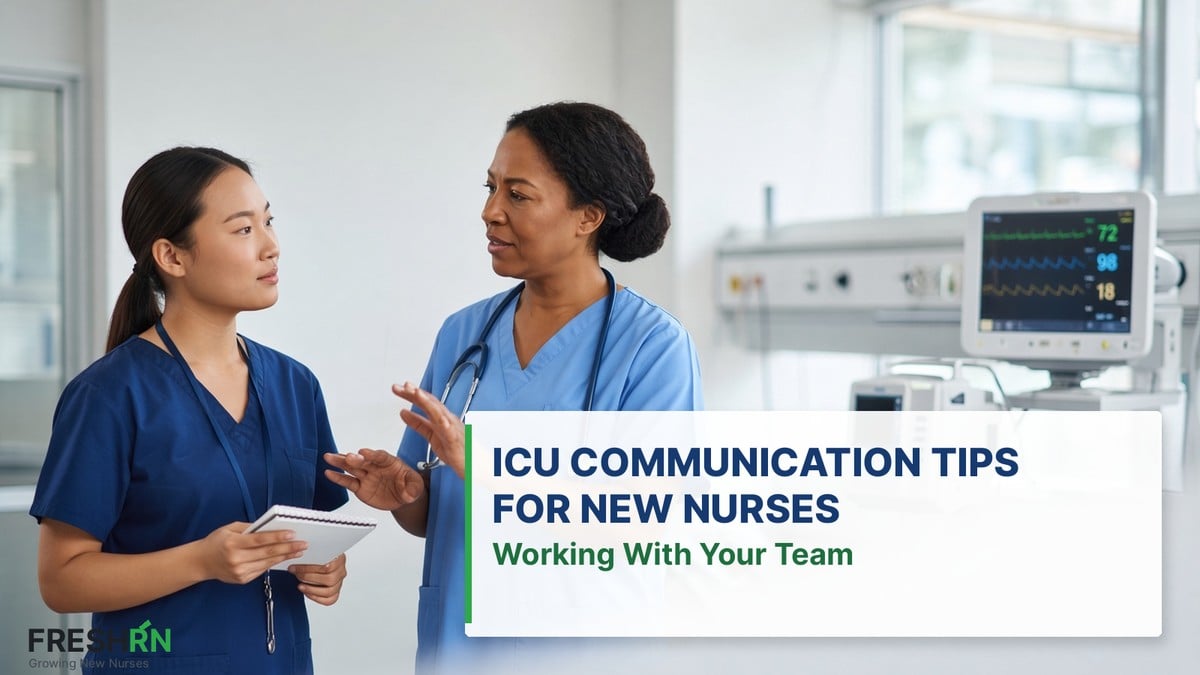
Practical ICU communication tips for new nurses: learn how to ask questions, speak up, and work with your team during your first months in critical care.
Continue Reading ICU Communication Tips for New Nurses: Working With Your Team

Cardiac nursing is very rewarding. Just when you think you’ve got it figured out, you’ll find something new. Let’s look at a Cardiac Nurse typical day.
Continue Reading Cardiac Nurse Responsibilities: A Typical Day on the Unit
ICU feeling like a whole new world? We’ve got you.

Built for nurses stepping into ICU who want to feel prepared, not overwhelmed. Breakthrough ICU gives you straight-to-the-point, real-world guidance on common ICU disease processes and treatments, equipment, report, and time management, so instead of playing catch-up, you’ll feel ready from day one.
See What’s Inside Breakthrough ICU →
0 Comments