
If you’re stepping into nursing (or maybe pivoting into a new specialty) and asking yourself: “should I go cardiac or neuro?”, this post is for you!
Both cardiology and neurology nursing are high-stakes, highly specialized, and absolutely vital to patient care. They’re also two of the most intimidating specialties for new nurses because the systems they focus on (the brain 🧠 and the heart ❤️) are literally life-or-death.
But while they share that intensity, they do feel very different on the floor. Let’s break down cardiology vs. neurology nursing together, and help you figure out which path is right for you.

Table of Contents
🫀 Cardiology Nursing: life in rhythm
Cardiac nurses care for patients with conditions ranging from heart failure to post-CABG recovery. You’ll see a mix of acute and chronic illness, and you’ll get very comfortable with things like:
- Managing chest tubes, arterial lines, and pacemakers
- Watching for arrhythmias (like afib with RVR)
- Monitoring post-cath lab or post-surgical patients
- Educating patients and families about lifestyle changes and long-term cardiac health
The pace in cardiology can be steady one minute and chaotic the next. One patient might be stable, while another suddenly flips into a dangerous rhythm. Cardiac nurses become pros at thinking fast, staying calm, and mastering that constant what-if vigilance.
🧠 Neurology Nursing: reading between the lines
Neuro nursing, on the other hand, is all about subtlety. 👀 While cardiac changes can sometimes be obvious (a monitor alarm, a rhythm strip, a crashing blood pressure), neuro changes are often tiny, almost imperceptible… until they’re not.
As a neurology nurse, you’ll focus on:
- Performing detailed neuro assessments (conscious and unconscious)
- Detecting subtle changes that could signal a stroke or brain bleed
- Caring for post-craniotomy or thrombectomy patients
- Supporting families through overwhelming diagnoses and long recoveries
The work is deeply detail-oriented. You’re not just checking a neuro assessment, you’re interpreting it, comparing it to yesterday, and communicating those changes clearly to neurologists or neurosurgeons. Neuro nursing also requires a lot of patient and family teaching, often at very emotional moments.
⚖️ Cardiology vs. Neurology Nursing: a quick comparison
Sometimes it helps to see the big picture. Here’s a side-by-side breakdown of what each specialty looks like:
| Category | Cardiology Nursing 🫀 | Neurology Nursing 🧠 |
|---|---|---|
| Focus | Heart and circulatory system | Brain, spinal cord, and nervous system |
| Pace | Can shift quickly from stable → emergency (arrhythmias, chest pain, codes) | More steady, but requires constant vigilance for subtle neuro decline |
| Skills | Rhythm interpretation, chest tubes, arterial lines, post-op monitoring | Detailed neuro exams, stroke care, monitoring post-craniotomy patients |
| Patient Education | Lifestyle modifications, medication adherence, cardiac rehab | Stroke prevention, seizure precautions, explaining complex neuro patho simply |
| Communication | Frequent with cardiologists, surgeons, cath lab teams | Frequent with neurologists, neurosurgeons, and families in crisis |
| Best for Nurses Who… | Like fast action, clear protocols, and high-tech equipment | Are detail-oriented, patient, and love connecting subtle dots |
➡️ Both cardiology and neurology can be launch pads into advanced practice roles like NP or CNS, or you might simply want to sharpen your skills with focused training.
💪 Skills you’ll build in each specialty
Cardiology Nurse Skills
- Rhythm recognition under pressure
- Hemodynamic monitoring and device literacy
- Safe titration of vasoactive medications
- Crisp communication during rapid changes
Neurology Nurse Skills
- Efficient, meaningful neuro checks
- Stroke timelines and escalation cues
- Translating subtle findings into clear updates
- Trending, reassessing, and advocating early
🤔 So… which one is better?
I’m your nurse big sis, so here’s the kinda annoying truth: neither. It’s about fit: for your season, your wiring, and your goals.
- Cardiology offers fast feedback and numbers you can move.
- Neurology rewards meticulous exams and quiet pattern-spotting.
Both are incredible places to grow, so my suggestion is to pick one that suits your interests, skills, and personality the best, and go for it!
🎓 Want to strengthen your skills before you start?
If you’re leaning cardiac or already accepted a tele/stepdown/CVICU role, the FreshRN Cardiac Crash Course is a great companion. It bridges the gap from nursing school to real life on the unit. You’ll get a focused brush-up on cardiac anatomy and physiology, learn what to watch for after cath lab and common cardiac surgeries, and build confidence managing bedside equipment like arterial lines and chest tubes. You’ll also practice how to respond when a patient flips into atrial fibrillation with RVR, so you don’t freeze when it really happens… and so much more!
👉 Learn more about Cardiac Confidence below ⬇️

Cardiac nursing can feel like you're drowning in alarms, rhythms, and unfamiliar meds before you even get report, and you're expected to keep up. But here's the truth: you don’t need to know everything, you just need to know what matters most.
Cardiac Confidence was created by experienced nurses to help you cut through the noise. We cover what actually shows up in real life: like post-cath care, recognizing unstable rhythms, caring for chest tubes, and knowing when to escalate (and a lot more).
No fluff, no advanced cardiac stuff you don’t need yet. Just focused, foundational info that makes a big difference.
Start Lesson #1 Now
And if neuro’s calling your name? Check out the Neuro Crash Course, a packed, practical guide designed for new neuro nurses who want to hit the ground running. Inside, you’ll learn how to perform solid neuro assessments (on both awake and unconscious patients), recognize and communicate early signs of neuro decline, and get comfortable with the equipment you’ll use most, like EVDs and ICP monitoring. You’ll also get a roadmap for thriving during orientation and sounding confident during neuro report.
👉 Learn more about Neuro Wise below ⬇️

Neuro is a specialty that can feel intimidating at first. There’s a ton of new terminology, patient conditions can change fast, and neuro assessments are way more nuanced than they seem. It’s a lot to take in—but you don’t have to figure it out alone. Neuro Wise is the course we wish we had as new neuro nurses. It breaks down complex neuro concepts into easy-to-understand lessons, so you can confidently assess your patients, give a solid neuro report, and actually understand what’s going on—not just go through the motions. We cover everything you need to know—so you can step onto the unit feeling prepared, not panicked.
Start Lesson #1 Now
💡 Final thoughts on cardiology vs. neurology nursing
Here’s the truth: neither one is “better.” Like I said, it’s about the right fit for your season, your goals, and your personality.
- If you like fast action and thrive under pressure → cardiology might feel like your zone.
- If you’re detail-oriented and love interpreting subtle changes → neurology could be your calling.
And remember, nursing is flexible. You’re never locked in forever. Many nurses start in one specialty and later shift into the other, or even move into leadership, education, or advanced practice roles.
Whichever you choose, know this: you’ll be building a skill set that saves lives and shapes patient outcomes in profound ways.
🧰 More Resources for FreshRNs
- ❤️ Nervous about cardiac rhythms? Grab our FREE Afib with RVR Mini-Course
- 🧠 Want more neuro support? Check out the FREE Conscious Neuro Assessments Mini-Course
📚 Related posts:
- Med Surg vs ICU: Which is Right For Me?
- Cardiac Review Course for Nurses: Build Confidence and Master the Essentials
- New Neuro Nurse Review Course for Beginners
📊 Still exploring nursing programs? Use our partner’s tool below to compare schools near you based on your goals.
Don’t be intimidated! Follow these tips for working with physicians and banish your nursing anxiety for good.
Continue Reading Working With Physicians: 8 Tips Every New Nurse Should Know
People pleasing in nursing leads to perfectionism, burnout, and anxiety. Learn how to break the cycle and build a more confident, compassionate identity.
Continue Reading People Pleasing in Nursing: How Perfectionism Leads to Burnout
Wondering if your preceptor is just tough, or actually toxic? Here’s how to spot the red flags of bullying, protect your mental space, and navigate this tricky dynamic like a pro nurse (without losing your mind).
Continue Reading Is Your Preceptor a Bully? Here’s How to Tell and What to Do
If you have to write out goals for nursing evaluations during your performance review process, I go over a few great ideas and ways you can structure yours!
Continue Reading 32 Powerful Goals for Nursing Evaluations to Help You Succeed
Practical ICU communication tips for new nurses: learn how to ask questions, speak up, and work with your team during your first months in critical care.
Continue Reading ICU Communication Tips for New Nurses: Working With Your Team

Cardiac nursing is very rewarding. Just when you think you’ve got it figured out, you’ll find something new. Let’s look at a Cardiac Nurse typical day.
Continue Reading Cardiac Nurse Responsibilities: A Typical Day on the Unit
Wish Your 12-Hour Shift Had A Map?👇
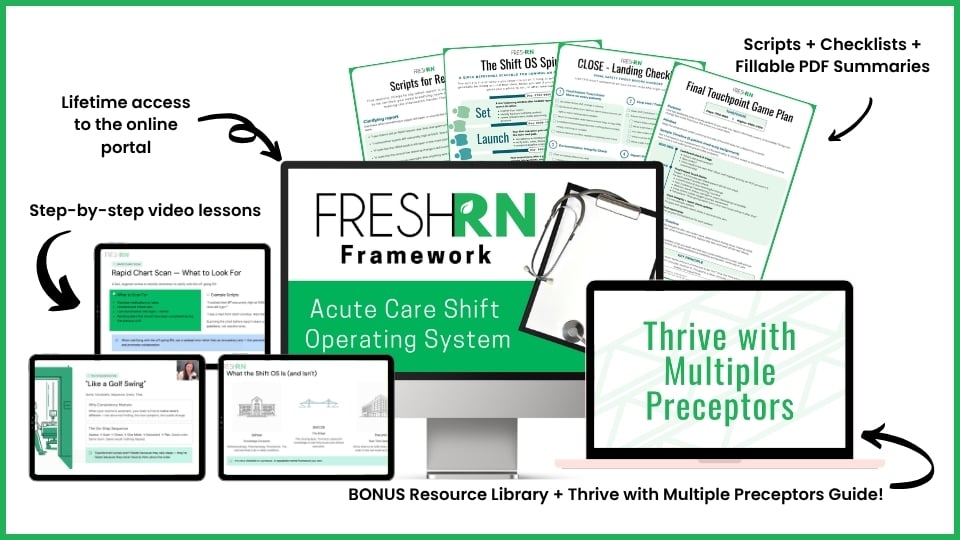
Turn a chaotic 12-hour acute care shift into a clear, structured rhythm. We cover: how to launch after report, prioritize when everything feels urgent, and finish with a clean handoff.
See What’s Inside Shift OS →

0 Comments