
If you’ve ever been handed a chart with a bunch of listed “allergies”, you know how overwhelming it can feel.
- Are these real allergies or just side effects?
- Can I safely give this antibiotic?
- Do I have to call the provider about all of these?
In this episode of the FreshRN Podcast, I sat down with Sophia L. Thomas, DNP, APRN, FNP-BC, PPCNP-BC, FNAP, FAANP, former President of the American Association of Nurse Practitioners and long-time NP at DePaul Community Health Centers, to talk about how to do a nursing allergy assessment that’s actually useful, safe, and not totally overwhelming.
Instead of just running down a checklist, we dug into how nurses can ask clearer questions, sort out true allergies from side effects, and document in a way that genuinely supports safe, efficient patient care.
We also explored situations where tools like penicillin allergy delabeling and IgE blood testing can make a big difference, plus some high-impact pitfalls every nurse should know, like alpha-gal syndrome (and its connection to heparin) and surprising food-pollen cross-reactivities that can complicate diet orders and treatment choices.
You can listen to the full conversation here 👇
Below, I highlight some of the key insights we talk about for bedside nurses, educators, and nurse leaders who want to strengthen their approach to nursing allergy assessment and improve safety without adding unnecessary complexity.
Table of Contents
Why Nursing Allergy Assessment Is So Important
Nurses are usually the first ones to verify allergies in real time:
- At admission
- In triage
- Before the first antibiotic dose
- Before that “just a quick” heparin injection or contrast study
A sloppy or rushed allergy screen can lead to:
- Delays in care because “everything is an allergy”
- Patients being denied the best medication because of an unverified label
- Serious reactions if a true allergy is missed
- Long-term issues when unverified allergies follow the patient across health systems
A good nursing allergy assessment does two critical things:
- Protects the patient from true immune-mediated reactions.
- Gives the team accurate information so we don’t unnecessarily limit treatment options.
And here’s the part nurses don’t always get credit for:
You’re not just “checking a box”, you’re shaping the entire plan of care with how you take (and clarify) that allergy history.
Allergy vs Sensitivity vs Side Effect: A Quick Framework
This is where new nurses usually feel stuck. Patients say “I’m allergic” to everything from morphine to gluten to Benadryl… and you’re left trying to sort it out. Here’s a simple way to frame it, straight from Dr. Thomas.
1. True Allergy = Immune-Mediated Reaction
A true allergy involves the immune system. Think:
- Hives or rash (urticaria)
- Lip/tongue/throat swelling
- Wheezing or trouble breathing
- Anaphylaxis
- Itchy mouth/throat, swelling after certain foods
This is your “do not give again without serious discussion” category.
2. Sensitivity / Intolerance
This is not driven by the immune system. It can be very uncomfortable, but it’s not the same as anaphylaxis risk. Examples:
- Lactose intolerance – gas, bloating, diarrhea
- Gluten sensitivity – GI discomfort without celiac disease
- Certain foods that “my stomach just doesn’t like”
Still important to document, but different from an immune-mediated allergy.
3. Side Effect
A predictable, known effect of a medication. For example:
- “Morphine makes me sleepy.”
- “Benadryl knocks me out.”
➡️ That’s not an allergy, that’s the med doing what it does.
A helpful line from Dr. Thomas:
Sensitivity + symptoms = true allergy. Sensitivity alone, without those immune-type symptoms, is not.
How to Ask Better Allergy Questions (Instead of Just Typing NKA/NKDA)
If you only ask, “Are you allergic to any medications?” you’ll miss a lot.
A stronger nursing allergy assessment sounds more like:
- “Are you allergic to any medications?”
- “Are you allergic to any foods?”
- “Any allergies to latex, contrast dye, or environmental things like pollen or animals?”
- “When you say you’re allergic to ___, what exactly happens when you take it?”
- “How old were you when that happened?”
- “Have you ever taken anything similar since then?”
And for patients who answer “I have sinus” or “I have bad seasonal allergies”, that’s allergic rhinitis, and it belongs in their history too. Your goal is to turn “Allergy: Yes/No” into a tiny story that actually helps the team make decisions.
Penicillin Allergy: Why It Matters (and When to Think About Delabeling)
“Penicillin allergy” is one of the most common entries you’ll see in charts, especially in pediatrics. But much of it (as you may have already guessed) is… not accurate. Classic scenario:
- Child has a viral illness, is given amoxicillin anyway.
- A few days in, they develop a viral exanthem, a rash from the virus, not the drug.
- The family is told (or assumes), “They’re allergic to penicillin.”
- Ten years later, it’s still in the chart.
The problem? That allergy label follows them everywhere and can:
- Remove first-line antibiotics from the toolbox
- Push providers to use broader-spectrum, more expensive, or less ideal antibiotics
- Contribute to resistance and longer hospital stays
Many hospitals are now implementing penicillin allergy delabeling programs in collaboration with pharmacists, allergists, and medical providers. These teams review the patient’s clinical history, order appropriate testing or supervised challenges when needed, and ultimately remove inaccurate allergy labels from the chart.
Nurses play a crucial role in getting that process started by asking patients what actually happened when they took penicillin, documenting the specific symptoms they experienced (whether it was just a rash, true hives, swelling, or signs of anaphylaxis) along with when the reaction occurred. When something in the allergy list doesn’t quite add up, flagging it for provider review can make all the difference. You might not be the one delabeling the allergy, but your assessment and documentation often lay the groundwork for it to happen safely.
Alpha-Gal Syndrome and Heparin: The Sneaky Pitfall
One of the high-impact pearls Dr. Thomas shared: alpha-gal syndrome.
Quick rundown:
- Alpha-gal is a tick-borne condition.
- Patients develop an allergy to mammalian meat (beef, pork, lamb).
- This can also extend to products derived from mammals.
Why this matters in acute care:
Heparin is derived from animal sources.
If a patient with alpha-gal receives heparin, they can have a serious allergic reaction. So, in your nursing allergy assessment:
- If a patient mentions alpha-gal syndrome or “a red meat allergy,”
- Or a history of tick bites and weird reactions to meat,
…flag that and double-check any heparin orders with the provider and pharmacy.
This is a great example of why nursing allergy assessment isn’t just about drugs, medical conditions and history matter too.
Food Allergies, Cross-Reactivity, and Diet Orders
Food allergies aren’t just “nice to know” details, inside the hospital, they can directly affect diet orders, medication choices, and overall patient safety. For example, Dr. Thomas explained how birch-apple cross-reactivity can catch teams off guard: a patient who tests positive for a birch tree allergy may also experience oral itching or swelling when eating apples. If that patient is receiving regular meals during their stay, dietary absolutely needs to know so those foods can be avoided.
Common food allergens you’ll see include:
- Milk
- Eggs
- Soy
- Wheat
- Peanuts
- Tree nuts
- Sesame
- Fish and shellfish
Accurate documentation helps the entire team. Dietary can prevent unsafe foods from appearing on trays, providers can select medications without problematic excipients, and nurses can avoid those confusing “mystery” reactions that sometimes appear after meals. When something seems unclear, or if the patient reports a food reaction that could matter during their stay, add a quick note for dietary and be sure to highlight it during handoff.
Pediatric Asthma, Eczema, and Allergy: Seeing the Pattern
If you work with kids (or adults who were “that kid”), watch for the classic allergic triad:
- Asthma
- Eczema (atopic dermatitis)
- Allergic rhinitis (“sinus,” “seasonal allergies,” always congested)
Kids who show up to the ER every fall with asthma attacks? That’s your cue to think:
This isn’t just bad luck. This might be an uncontrolled allergy.
As a nurse, you can:
- Notice patterns (same season, same triggers)
- Encourage families to talk to their primary care provider about allergy testing
- Reinforce asthma education (“rule of twos”: waking up with symptoms ≥2 times per week, etc.)
Those repeated asthma visits are often preventable if the underlying allergy is identified and managed.
IgE Blood Testing vs Skin Testing: What Nurses Should Know
We’re used to thinking of allergy testing as the classic skin prick test, lots of little scratches on the back or arms, and the patient has to stop antihistamines for days. Those still exist and are useful. But Dr. Thomas highlighted another powerful tool: allergen-specific IgE blood testing.
Why it’s such a game-changer:
- Can be ordered from primary care (doesn’t require an allergist visit to start)
- Requires just 1 mL of blood
- Can be done in infants and children, even with severe eczema
- Does not require stopping antihistamines beforehand
- Can test for environmental and food allergens, often with component-level detail
As a nurse, you’re not ordering the tests, but you can:
- Suggest to families: “Ask your primary care provider about allergen-specific IgE testing.”
- Reinforce that knowing triggers can prevent ER visits, not just “add more meds.”
- Normalize allergy testing as part of smart, proactive care, especially in kids with eczema + asthma + “sinus” (allergic rhinitis).
Documentation Tips: Turn Your Allergy Assessment Into Actionable Data
A strong nursing allergy assessment is only as good as the documentation that follows. Here are a few practical tips:
- Document the substance and the reaction:
- “Amoxicillin – hives and lip swelling 2 hours after dose (age 8).”
- “Morphine – nausea only, no rash or swelling.”
- Avoid vague entries like “Penicillin – unknown reaction, childhood” without at least noting that it’s unclear.
- Note if a reaction sounded like a side effect (e.g., “drowsiness only; patient labels as allergy”).
- Highlight any life-threatening reactions (anaphylaxis, airway involvement, hypotension).
- Call out important food and medication allergies in handoff and SBAR.
And if something worries you, like alpha-gal, a very long allergy list, or unclear “allergic to all antibiotics” claims 👉 escalate it to the provider or pharmacist. You are absolutely allowed (and encouraged) to say: “Can we clarify this allergy history? It’s really limiting options.”
One Big Takeaway for New Nurses
Dr. Thomas summed it up beautifully:
‘Ninety percent of your encounter is history. If you get a really good history, you can already figure out what direction you need to go with, based on the symptoms and the signs that they’re telling you.’
For nursing allergy assessment, that means:
- Don’t rush past the allergy screen just to fill in NKDA or a long list.
- Take a moment to ask, “What actually happened?”
- Document clearly enough that someone reading it later can picture the event.
- Bring anything serious or confusing directly to the provider’s attention.
You’re not “just” doing intake, you’re preventing reactions, expanding treatment options, and sometimes even changing the trajectory of someone’s chronic disease!
🧰 More Resources
- Connect with Dr. Sophia L. Thomas
- 📚 Medication & Safety Resources on FreshRN
- 🧑⚕️ For Nurse Leaders – FreshRN Enterprise If you’re building or improving a nurse residency or transition-to-practice program, check out FreshRN Enterprise for ready-made education and support for your nurses.

Don’t be intimidated! Follow these tips for working with physicians and banish your nursing anxiety for good.
Continue Reading Working With Physicians: 8 Tips Every New Nurse Should Know
People pleasing in nursing leads to perfectionism, burnout, and anxiety. Learn how to break the cycle and build a more confident, compassionate identity.
Continue Reading People Pleasing in Nursing: How Perfectionism Leads to Burnout

Wondering if your preceptor is just tough, or actually toxic? Here’s how to spot the red flags of bullying, protect your mental space, and navigate this tricky dynamic like a pro nurse (without losing your mind).
Continue Reading Is Your Preceptor a Bully? Here’s How to Tell and What to Do
If you have to write out goals for nursing evaluations during your performance review process, I go over a few great ideas and ways you can structure yours!
Continue Reading 32 Powerful Goals for Nursing Evaluations to Help You Succeed
Practical ICU communication tips for new nurses: learn how to ask questions, speak up, and work with your team during your first months in critical care.
Continue Reading ICU Communication Tips for New Nurses: Working With Your Team

Cardiac nursing is very rewarding. Just when you think you’ve got it figured out, you’ll find something new. Let’s look at a Cardiac Nurse typical day.
Continue Reading Cardiac Nurse Responsibilities: A Typical Day on the Unit
Wish Your 12-Hour Shift Had A Map?👇
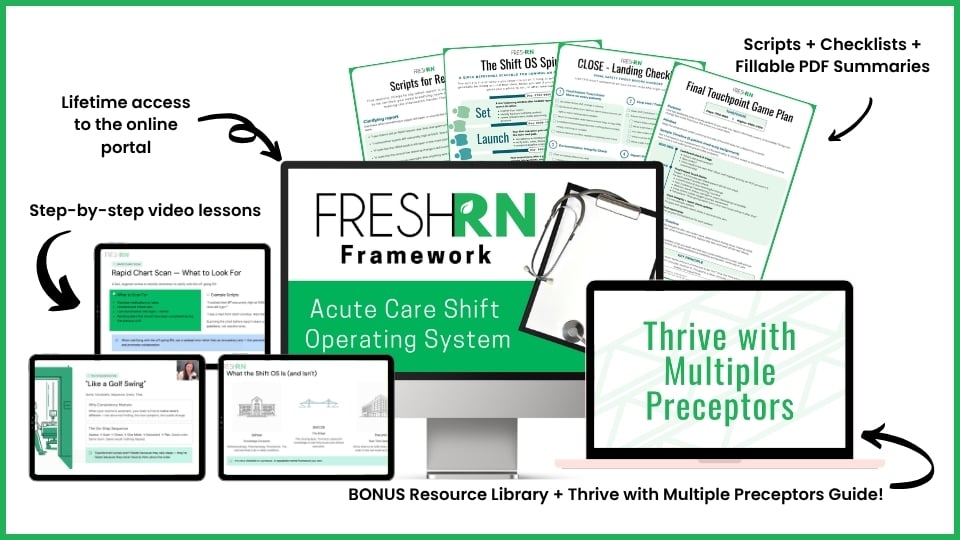
Turn a chaotic 12-hour acute care shift into a clear, structured rhythm. We cover: how to launch after report, prioritize when everything feels urgent, and finish with a clean handoff.
See What’s Inside Shift OS →

0 Comments