
When you hear “virtual nursing,” you might picture something futuristic and disconnected from real patient care: screens, dashboards, and someone miles away making decisions. But what if virtual nursing models could actually make bedside nursing feel more supported, more team-based, and more aligned with the kind of professional practice you went to school for?
In this episode of the FreshRN Podcast, I talked with Dr. Bethany Robertson, DNP, CNM, FNAP, Clinical Executive at Wolters Kluwer, about what nurse leaders are really seeing in the future of nursing care delivery. Her team helped develop the Future Care Nursing 2025 report, and one of the most surprising findings was just how widespread virtual nursing has already become.
💡 66% of surveyed organizations reported implementing some form of virtual nursing.
And no, it’s not just in the ICU. It’s showing up all over acute care, especially on med surg units. Let’s unpack what that actually looks like, why leaders are so interested in virtual nursing models, and what this means for both new grads and seasoned nurses.
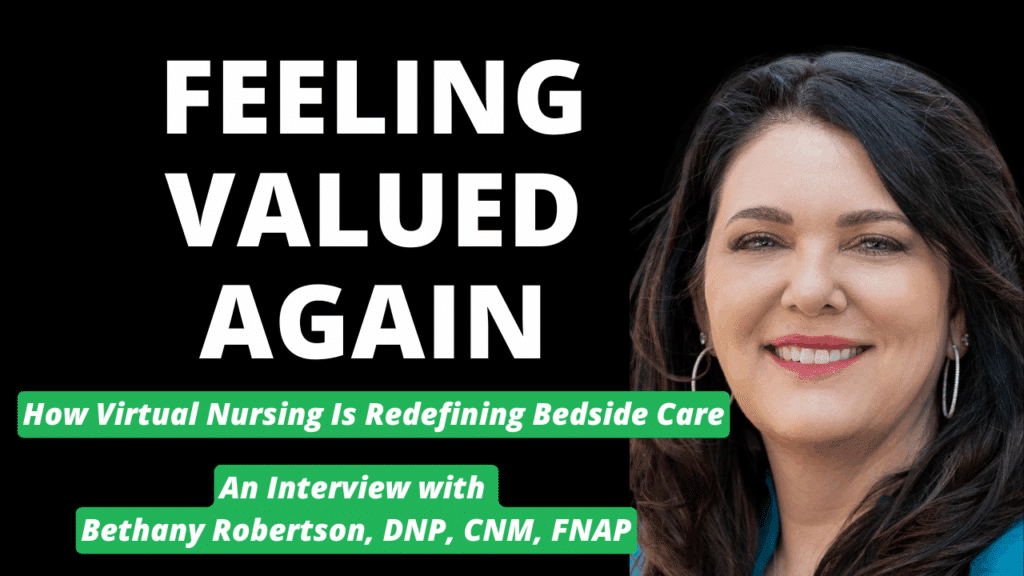
You can listen to the full conversation here 👇
Table of Contents
What Are Virtual Nursing Models, Really?
Dr. Robertson described virtual nursing in a simple way:
There is a nurse who is not physically in the room but is part of the care team; joining virtually to provide specific support in real time.
That virtual nurse might be:
- On-site in a dedicated “hub”
- At an off-site command center
- Working remotely from home
- Rotating between bedside shifts and virtual nursing shifts
The common thread in these virtual nursing models isn’t where the nurse sits, it’s what they’re doing:
- Supporting admission and discharge processes
- Helping with documentation and patient education
- Backing up call lights and triaging patient needs
- Coordinating with CNAs, therapists, and other team members
- Providing mentorship and preceptor-like support to newer nurses
Instead of replacing bedside nurses, virtual nursing in acute care is being designed to offload the cognitive and administrative overload that makes nursing feel impossible some days.
Why Virtual Nursing Models Are Growing So Fast
As Dr. Robertson put it, the workload in acute care has surpassed what any one nurse can manage safely. ⚠️
Compared to 20-30 years ago:
- Patients who used to be on med surg are now in stepdown or ICU.
- Patients who used to be on the floor for days are now outpatient or “hospital at home.”
- The med surg nurse is often caring for sicker patients with higher acuity, but with the same or even fewer resources.
On top of that, nurses are expected to:
- Complete more regulatory and quality documentation
- Meet value-based care goals and patient experience metrics
- Coordinate complex discharges
- Keep up with constant new technology, protocols, and devices
It’s not just “busy.” It’s unsustainable.
So nurse leaders are asking a different question:
Instead of just adding more bodies, how do we redesign the care delivery model?
That’s where virtual nursing models come in. They’re part of a bigger shift toward:
- Team-based care
- Collaborative care models
- Value-based care
- More care delivered in the home and community, not just the hospital
Virtual nursing is one tool in that toolbox.
How Virtual Nursing Looks on a Med Surg Unit
If you’re a med surg nurse, here’s how a virtual nursing model might show up in your day-to-day reality. You still have your usual assignment. You’re still assessing, coordinating, advocating, and doing the hands-on care. But now you also have a virtual nurse teammate who can:
- Jump into patient rooms via video to answer call lights
- Redirect simple requests (like water, a blanket, or a straw) to a CNA or tech
- Start an admission interview, gather history, and document important details
- Help with discharge teaching, reinforcing what the bedside nurse has already introduced
- Keep an eye on the flow of the unit (admissions, discharges, pending orders) and act like a sort of “air traffic control”
Instead of you trying to:
- Keep up with three new admissions
- Return every non-urgent call light
- Do discharge teaching
- Call the provider
- Coordinate a complex home health discharge
- And also remember labs, imaging, consults, and subtle clinical changes
…you now have someone whose entire job is to support that workflow.
That doesn’t mean the virtual nurse does all the “easy stuff” and you’re stuck with the hard stuff. It means tasks are redistributed so you can actually use your full skill set instead of spending your entire shift reacting to the next beep or box on the screen.
Virtual Nursing and Professional Satisfaction (Not Just “Happiness”)
Dr. Robertson made an important distinction:
When we talk about nurse satisfaction in these new care delivery models, we’re not talking about “Yay, I got a free lunch!”
We’re talking about:
- Professional identity
- Feeling valued for your clinical judgment
- Being able to practice at the top of your license
- Not feeling like you’re constantly failing to meet an impossible standard
When nurses spend most of their time:
- Doing tasks that don’t require critical thinking
- Drowning in admissions, discharges, and documentation
- Rushing from call light to call light with no time to actually think
…they don’t just feel tired. They feel devalued. And that is a fast path to burnout and turnover.
Virtual nursing models aim to say:
“We see the value of your thinking, not just your task completion. We’re redesigning care so you can actually use it.”
That’s huge. And nurse leaders are already seeing early signs that these models may help with:
- Nurse retention
- Recruitment (especially when advertised as a supportive, modern care model)
- Professional fulfillment
Does Virtual Nursing Change the RN or CNA Role?
From a scope of practice standpoint, not really. The RN role is still the RN role. The difference is how much of that scope you can realistically exercise when you’re not running on empty. 💨
Here’s what virtual nursing models can impact:
- Time spent documenting (especially as ambient listening and AI-assisted documentation grow)
- Time spent on non-urgent requests that don’t require nursing judgment
- Cognitive load related to tracking every small moving part in a complex assignment
- Availability of “backup” in real time when something feels off or overwhelming
It’s not that admission questions, discharge teaching, and call light responses aren’t important, they absolutely are. But they don’t all have to be done by the nurse who is also managing pressors, titrating oxygen, or watching a borderline patient like a hawk. By thoughtfully redistributing work, virtual nursing in acute care can help each team member (RN, LPN, CNA, virtual nurse) practice closer to the level where they bring the most value.
Documentation, Ambient Listening, and AI in Nursing
We also talked about AI and ambient listening technology as another piece of the future of nursing care delivery.
Think about all the time you’ve spent learning:
- A brand-new documentation system
- Exactly which boxes to click
- Where to copy/paste certain phrases
- How to chart something in three different places to satisfy audits
Now imagine this instead:
- You walk into a room, provide care, talk with the patient and family like you normally would.
- Ambient listening tech captures the conversation and actions.
- The system generates draft documentation based on what actually happened.
- You review, edit if needed, and approve.
And as we know that’s no longer science fiction, that’s already starting to roll out in different corners of healthcare. And just like with virtual nursing models, the point isn’t to replace nurses. It’s to:
- Reduce administrative burden
- Increase accuracy in capturing what really happened
- Free up brain space and time so nurses can focus on clinical thinking, connection, and coordination
➡️ For new grads especially, this could significantly lower the stress of “learning the charting system” on top of everything else.
What New Nurses Need to Know About Virtual Nursing Models
If you’re entering practice in the next few years, there’s a good chance you’ll work in a hospital experimenting with virtual nursing in acute care. You may not have a “before” to compare it to, this might just be normal for you. Here’s what will help you thrive:
1. Tech literacy is important, but it’s not everything
You don’t have to be a programmer. But you do need to be:
- Comfortable navigating digital tools
- Willing to learn new platforms over time
- Able to use tech to find reliable information quickly (instead of trying to memorize everything)
The good news? Most newer nurses are already strong here.
2. Teamwork is a core competency, not a “soft skill”
Virtual nursing models make the team even more important, not less. You’ll need to:
- Communicate clearly with colleagues who are both onsite and virtual
- Know how to articulate your needs and your uncertainties
- Be comfortable saying, “I’m not sure,” and looping others in
As Dr. Robertson put it:
“Uncertainty doesn’t equal incompetence. It’s just reality.”
The nurses who thrive in these new models aren’t the ones who pretend to know everything. They’re the ones who can work the system as a team sport.
3. Your professional fulfillment matters
If you find yourself in a role where you’re constantly doing low-level tasks and never getting to think, notice that. That feeling of “I went to school to do more than this” is valid. Care delivery models like virtual nursing are being built precisely because leaders are starting to realize how damaging that mismatch is. You’re allowed to want, and ask for, a practice environment that lets you use your full scope.
Looking Ahead: Hospital at Home, Community Care, and the Future
Beyond virtual nursing, Dr. Robertson also talked about larger trends in the future of nursing care delivery:
- More care shifting out of the hospital and into home and community settings
- Growth of hospital at home programs, where patients meet inpatient criteria but can safely be cared for at home with tech + paramedic + nursing support
- Emphasis on prevention, primary care, and population health
- Use of AI in more back-office processes (scheduling, supply chain, quality tracking), not just at the bedside
All of this points to a nursing future where:
- The sickest patients are in acute care for shorter, more intensive stays
- More nurses work in community, home health, and hybrid models
- Tech and virtual nursing models help hold the complexity together so humans can do what humans do best
It’s not a simple or linear shift. But underneath all of it is the same core question:
How do we design nursing care delivery so that nurses can actually do the work they were trained and called to do, and stay in the profession long enough to make an impact? (I particularly resonate with this, since this is the whole reason I started FreshRN!)
Final Thoughts on Virtual Nursing Models and the Current Med Surg Reality
If you’re feeling the squeeze on med surg right now (too many patients, too many tasks, too many metrics) it’s not in your head. The job truly has changed. What’s encouraging about virtual nursing models and other innovations is that they’re not just about cutting costs or adding gadgets. Done well, they’re about:
- Protecting nurse cognitive capacity
- Re-centering care around teamwork and support
- Creating environments where nurses feel valued, prepared, and less alone
- Improving outcomes for patients and the people who care for them
We don’t know exactly what every unit will look like in 5-10 years. But if nurses stay at the table, leading, questioning, and co-designing these models, the future of nursing has the potential to be not just survivable, but deeply meaningful. 🌱
🧰 More Resources
- More on Dr. Bethany Robertson & Wolters Kluwer
- 🔍 Related Posts
- 🧑⚕️ For Nurse Leaders
- If you’re a nurse leader trying to support new grads, check out FreshRN Enterprise, a comprehensive residency and onboarding solution for hospitals.
Don’t be intimidated! Follow these tips for working with physicians and banish your nursing anxiety for good.
Continue Reading Working With Physicians: 8 Tips Every New Nurse Should Know
People pleasing in nursing leads to perfectionism, burnout, and anxiety. Learn how to break the cycle and build a more confident, compassionate identity.
Continue Reading People Pleasing in Nursing: How Perfectionism Leads to Burnout
Wondering if your preceptor is just tough, or actually toxic? Here’s how to spot the red flags of bullying, protect your mental space, and navigate this tricky dynamic like a pro nurse (without losing your mind).
Continue Reading Is Your Preceptor a Bully? Here’s How to Tell and What to Do
If you have to write out goals for nursing evaluations during your performance review process, I go over a few great ideas and ways you can structure yours!
Continue Reading 32 Powerful Goals for Nursing Evaluations to Help You Succeed
Practical ICU communication tips for new nurses: learn how to ask questions, speak up, and work with your team during your first months in critical care.
Continue Reading ICU Communication Tips for New Nurses: Working With Your Team

Cardiac nursing is very rewarding. Just when you think you’ve got it figured out, you’ll find something new. Let’s look at a Cardiac Nurse typical day.
Continue Reading Cardiac Nurse Responsibilities: A Typical Day on the Unit
What makes some nurses so dang sharp? Here's the secret.

You’re a good nurse, but you want to be a great one. Critical Thinking for Nurses teaches you how to notice subtle changes, make smarter decisions under pressure, and earn the respect of coworkers and providers alike (even that kinda intimidating one 👀).
See What’s Inside Critical Thinking →
0 Comments